
Vegetables
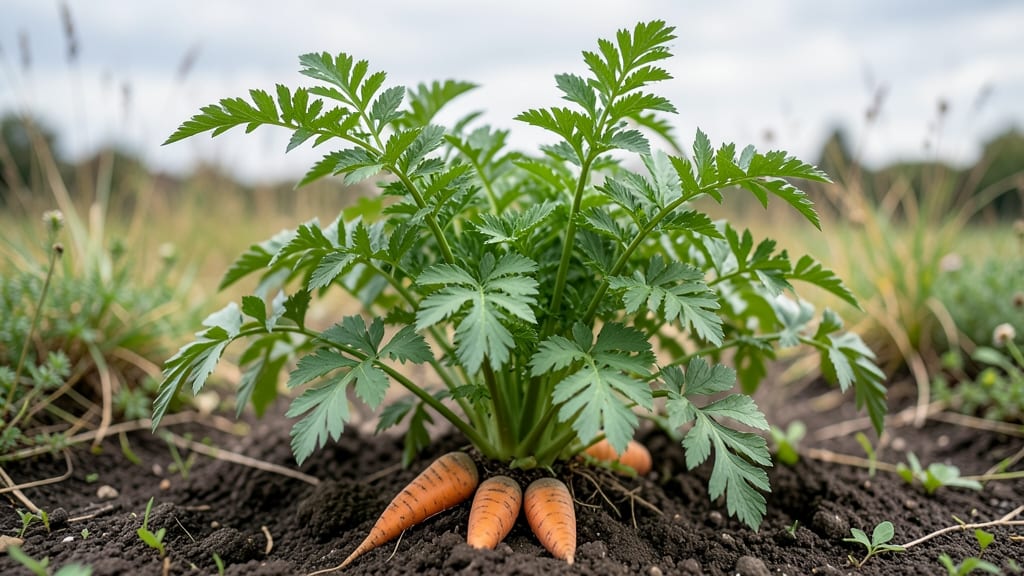
Carrots are biennials, not perennials, meaning they grow as annuals in most climates but can survive and regrow from the same root in ideal conditions, though they rarely produce edible roots after the first year.
This means carrots complete their life cycle in two years under perfect conditions, storing energy in their roots during the first year to fuel regrowth. 🌱 In warmer climates, they might even survive multiple years if undisturbed, though the quality of subsequent harvests declines.
The key difference from true perennials is that carrots don't produce new leaves or edible roots each season—they simply regenerate from the same root system.
What makes this interesting is how temperature triggers their second-year behavior. When exposed to cold weather, carrots send up flower stalks (bolting) as they prepare to reproduce.
This natural process explains why gardeners often see carrots "die back" in winter only to sprout again in spring—though the roots become tough and woody over time.
💡 In This Article
- Why Carrots Die Back and Regrow as Biennials
- How to Grow Carrots as Perennial-Like Plants
Why carrots die back and regrow as biennials
Carrots follow a biennial lifecycle because they store energy in their roots during the first growing season. Unlike true annuals (like radishes) that complete their entire life cycle in one year, carrots need two years to reach maturity under ideal conditions.
The root acts as an energy reservoir, storing carbohydrates like sucrose and starch that fuel regrowth when conditions are right. This storage system allows carrots to survive winter dormancy in USDA Hardiness Zones 5-9, where temperatures drop below 20°F but don't kill the root completely.
The trigger for their second-year behavior is photoperiodism—specifically, exposure to 10-14 hours of daylight during spring. When carrots sense longer days, they initiate bolting (sending up flower stalks) as part of their reproductive cycle.
The plant prioritizes seed production over root growth, which is why second-year carrots become fibrous and inedible.
This process is hardwired into their genetics, similar to how biennial plants like onions or beets behave. 🌱 What's fascinating is how the root's vascular system redirects nutrients from storage to flower development during bolting.
Temperature plays a crucial role in this lifecycle. Carrots grown in cooler climates (Zones 3-4) may complete their entire biennial cycle in two years, while those in warmer regions (Zones 9-10) might attempt regrowth annually if left undisturbed.
The root's ability to regenerate depends on how well it stores energy—carrots grown in nutrient-rich, well-drained soil with 60-80% moisture during the first season have the best survival rates.
This is why gardeners often see carrots "die back" in winter only to sprout again in spring, though the quality declines with each subsequent cycle.
Here's what happens biologically: The root's cambium layer (growth tissue) remains active even during dormancy, allowing limited regrowth when conditions improve. However, each regrowth cycle weakens the root's ability to store energy efficiently.
After 2-3 years, the root typically becomes too woody to produce edible carrots, though it may still survive as a living plant. This explains why commercial carrot farmers treat them as annuals—they harvest before the second-year decline sets in.
Consider this comparison: True perennials like asparagus regrow from their crowns each year, producing new shoots annually. Carrots, however, rely solely on their root's stored energy, making them more like "living storage organs" than true perennials.
Their ability to regrow stems from this unique energy storage mechanism, which is why they exhibit perennial-like behavior without being true perennials. 💫
The science behind this involves plant hormones called gibberellins, which promote stem elongation during bolting. These hormones are produced in response to temperature changes and daylight length, creating the perfect storm for the carrot's second-year transformation.
Understanding this process helps explain why gardeners in mild climates sometimes get "volunteer" carrots sprouting in subsequent years—it's not true perennial behavior, but rather the root's remarkable ability to persist under the right conditions.