
Flowers
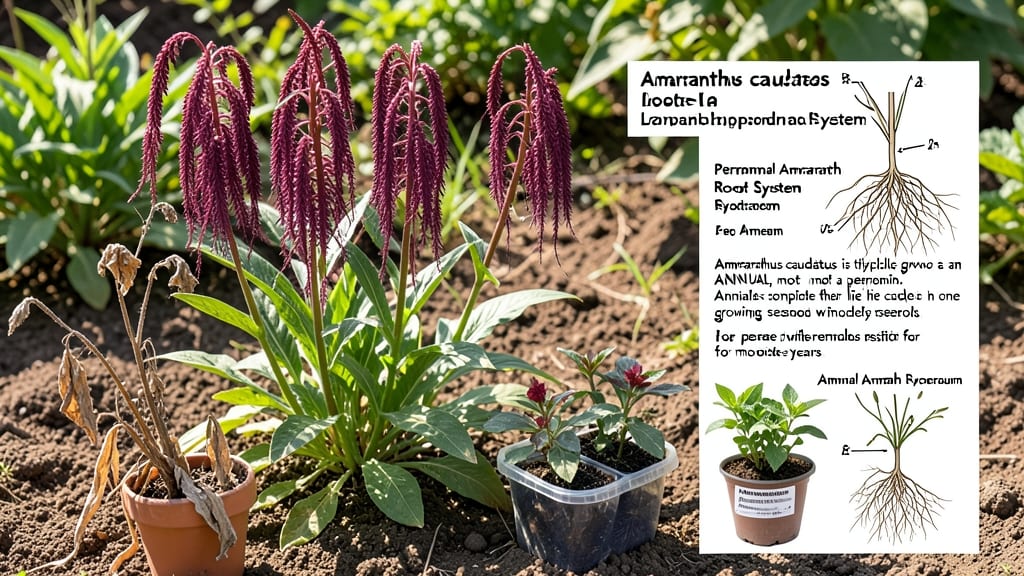
Amaranthus is not a true perennial in most climates, as it typically dies back after frost but can regrow from seed in warm seasons. Some tropical varieties may survive mild winters, but cold-hardy types like Amaranthus caudatus or A. tricolor are often grown as annuals in temperate zones.
Amaranthus behaves like an annual in most gardens because its tender stems and leaves won't survive freezing temperatures. 🌱 Even varieties labeled "perennial" in catalogs often die to the ground in USDA zones below 8, though their seeds may sprout again the following spring.
The key difference lies in their growth habit—some species like A. hypochondriacus produce prolific seed heads that ensure natural regeneration, while others rely on gardeners to save seeds for next year's planting.
For gardeners in cooler regions, treating amaranthus as an annual simplifies care—no need for winter protection or complex overwintering strategies.
However, if you're determined to extend its growing season, selecting cold-tolerant varieties and using row covers during early spring can give you a head start on growth before summer heat arrives.
💡 In This Article
- Amaranthus Cold Tolerance by Species and Variety
- Growing Amaranthus as a Perennial in Cold Climates
Amaranthus cold tolerance by species and variety
Amaranthus species are classified as short-lived perennials or annuals depending on their native habitat and genetic hardiness. Most varieties—like the popular love-lies-bleeding (Amaranthus caudatus)—act like annuals because their tender stems and leaves cannot withstand temperatures below 28°F (-2°C).
These species originate from tropical and subtropical regions where frost is rare, so their survival strategy relies on rapid growth and prolific seed production rather than cold resistance.
The hardiness zone range for most amaranthus varieties falls between USDA zones 8-11, meaning they'll survive winters only in mild coastal or desert climates. For example, Amaranthus tricolor (Joseph's Coat) can tolerate brief dips to 25°F (-4°C) but will suffer leaf damage below 20°F (-7°C).
In contrast, Amaranthus hypochondriacus (Prince's Feather) has slightly better cold tolerance, enduring up to 20°F (-7°C) for short periods, but still dies back in freezing conditions.
What makes amaranthus behave like a perennial in some cases is its seed germination strategy. Even if the plant dies back, the seeds often survive in the soil and sprout again when temperatures rise above 50°F (10°C) in spring.
This self-seeding ability creates the illusion of perennial growth, especially in regions with mild winters where seeds aren't buried too deeply. However, this isn't true perennialism—it's more like a volunteer annual system where the plant relies on its own seed bank rather than persistent roots or crowns.
For gardeners in USDA zones 5-7, where winters drop below 0°F (-18°C), amaranthus will almost certainly die back completely. The only way to "perennialize" it is through annual replanting from saved seeds or by starting new plants each spring.
Some tropical varieties, like Amaranthus dubius (Slender Amaranth), are even less cold-hardy, thriving only in zones 10-11 where frost is nonexistent.
The confusion arises because amaranthus can look perennial-like in its growth habit—it produces basal rosettes and can regrow from the base if cut back. However, this is a coppicing response (common in many annuals) rather than true winter survival.
True perennials, like asparagus or rhubarb, regrow from crowns or rhizomes that store energy underground, while amaranthus has no such structure in cold climates.
If you're growing amaranthus in zone 8 or warmer, you might see it survive winters with minimal protection, especially if mulched heavily with 6-8 inches of straw or leaves.
But even then, it's not a reliable perennial—more of a short-lived survivor that may regrow from the base or seeds the following year. The key takeaway is that amaranthus mimics perennials through seed persistence and rapid regrowth, but it lacks the biological adaptations for true winter hardiness.