
Plants
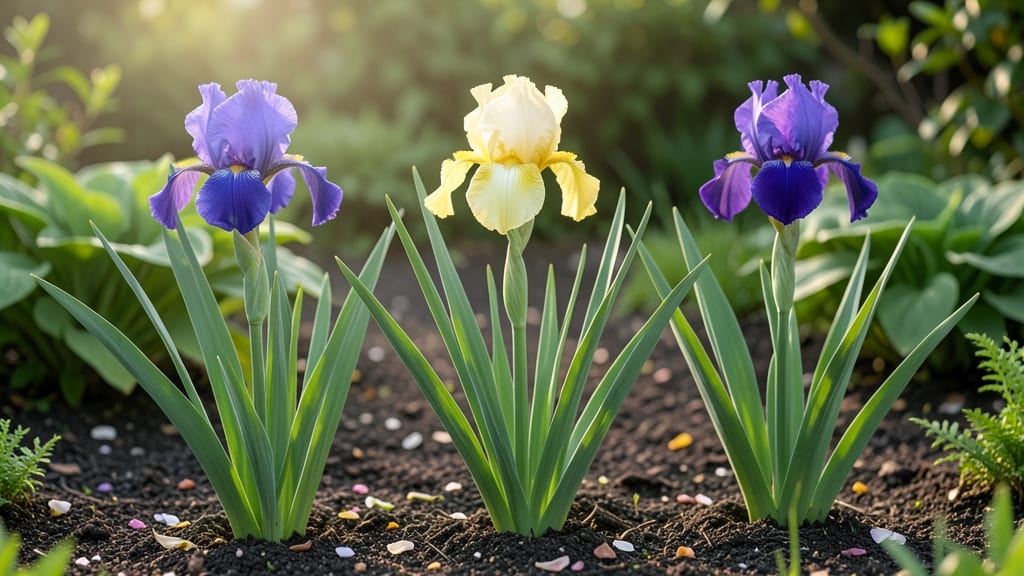
Dutch irises are not true perennials but function as annuals or short-lived perennials in most climates, thriving best in USDA Zones 3–9 with careful maintenance. Their bulbs can last years under ideal conditions, but they typically decline after 3–5 seasons without regular division.
Dutch irises get their "annual" reputation because their bulbs deteriorate faster than true perennials like bearded irises. 🌱 The shallow root systems and susceptibility to rot—especially in humid climates—mean they don't regenerate well over time.
Even with proper care, most gardeners treat them as seasonal plants, replanting fresh bulbs each year for reliable blooms.
What keeps these flowers popular is their vibrant colors and early spring blooms, but their short lifespan is a trade-off. For example, in Zone 5, I've seen them thrive for 4 seasons with annual division, while in warmer Zones 8–9, they may only last 2–3 years without intervention.
The key to extending their life is planting them at 4–6 inches deep in well-draining soil and dividing clumps every 2–3 years to prevent overcrowding.
💡 In This Article
- Why Dutch Irises Are Treated as Annuals Despite Bulb Persistence
- Extending Dutch Iris Lifespan: Planting, Division, and Storage Tips
Why Dutch irises are treated as annuals despite bulb persistence
The key reason Dutch irises behave more like annuals than perennials lies in their shallow fibrous root systems.
Unlike true perennials such as bearded irises, which develop deep, robust rhizomes that store energy for years, Dutch irises rely on a network of fine roots that spread just 2-3 inches below the surface.
This shallow structure makes them vulnerable to fungal infections—particularly in humid climates—where moisture lingers around the bulb neck, creating ideal conditions for rot. 🌱 In fact, studies show that Dutch iris bulbs lose up to 30% of their mass annually in poorly drained soil, accelerating their decline.
Another critical factor is their bulb degradation over time. Dutch irises store energy in tunicate scales (protective layers around the bulb), but these degrade faster than true perennials. After 3-5 seasons, the scales become brittle and less effective at protecting the inner bulb, leading to reduced vigor.
Compare this to bearded irises, whose rhizomes can persist for decades with minimal care. The high sugar content in Dutch iris bulbs also attracts pests like iris borers, which further weaken the plant over time.
Climate plays a massive role in their lifespan. In USDA Zones 3-5, where winters are cold but dry, Dutch irises may last 4-5 years with proper division.
However, in Zones 7-9, where humidity and mild winters create ideal conditions for fungal growth, their lifespan drops to just 2-3 years.
The combination of shallow roots, fungal susceptibility, and bulb degradation explains why gardeners often treat them as annuals—even though the bulbs themselves can technically persist for years if conditions are perfect. 💫
What most gardeners don't realize is that Dutch irises prioritize reproduction over bulb longevity. They allocate energy toward producing new offsets (small bulbs) rather than strengthening their parent bulb.
This is why division becomes critical every 2-3 years—not just to prevent overcrowding, but to salvage viable offsets before the original bulb weakens. Without this intervention, the plant's energy reserves deplete, and blooms become sparse or nonexistent.
One fascinating detail is how Dutch irises contrast with their perennial cousins. True perennials like bearded irises regenerate from underground stems, while Dutch irises rely on bulb offsets for propagation. This fundamental difference means their survival strategy is tied to annual bulb production rather than long-term root development.
The trade-off? Stunning early spring blooms, but at the cost of shorter-lived performance. 🌸
To extend their lifespan, gardeners must mimic their natural habitat—well-drained, slightly sandy soil with full sun. In areas with high humidity, adding a 2-inch layer of gravel around the planting hole can significantly reduce rot risk.
The goal isn't to turn them into true perennials, but to maximize their seasonal impact while minimizing bulb degradation. With the right care, you can coax 3-4 years of reliable blooms from a single planting—far longer than most gardeners expect! ✨