
Plants
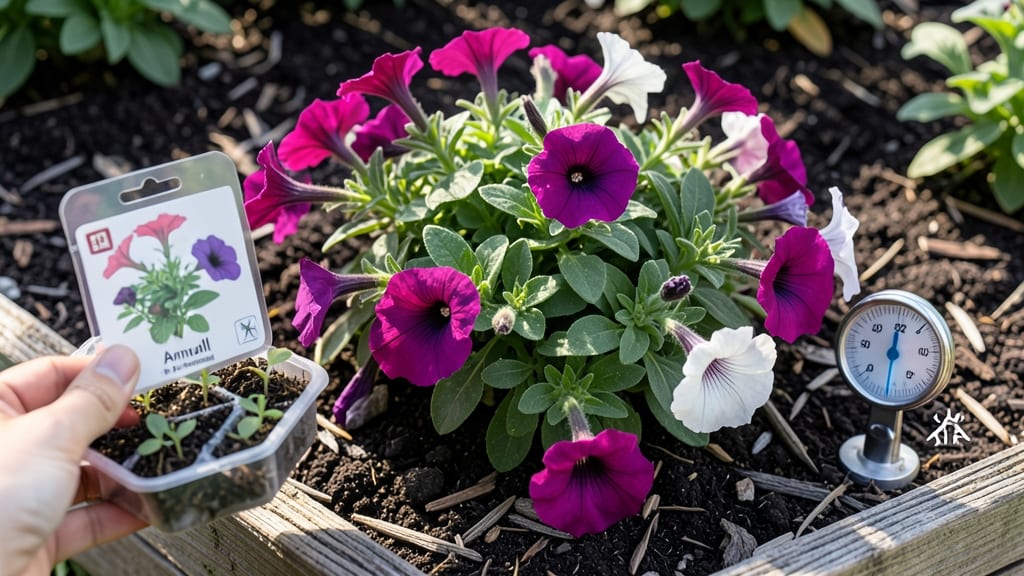
Petunias are not perennial plants in most climates, dying back after frost, but they self-seed prolifically in warm zones (USDA 9-11) or return from roots in mild winters. Cold-hardy varieties like Petunia × atkinsiana may survive in zones 8-9 with protection.
Petunias are actually annuals in most regions because their delicate stems and shallow roots can't survive freezing temperatures. 🌱 However, their ability to self-seed in warm climates (like Florida or Southern California) means they often look perennial by naturally regenerating each year.
For gardeners in cooler zones, selecting frost-tolerant varieties or using winter protection can extend their lifespan beyond a single season.
What sets these tender perennials apart is their tropical origins—they thrive in heat but wilt when temperatures drop below 32°F. The good news? With proper care, you can trick them into lasting longer than one growing season.
I've seen petunias bounce back from winter in zone 8 gardens when given extra insulation, proving they're more resilient than many assume.
💡 In This Article
- Why Petunias Die in Cold Climates: Freeze Sensitivity Explained
- How to Overwinter Petunias in Cold Regions
Why petunias die in cold climates: freeze sensitivity explained
Petunias originate from the tropical regions of South America, where temperatures rarely dip below 50°F. Their delicate stems and shallow root systems evolved for warm climates, making them highly sensitive to frost.
When temperatures drop to 32°F or below, the cell walls in petunia leaves rupture due to ice crystal formation—a process called freeze-induced dehydration. This causes the foliage to turn black and mushy within hours, signaling irreversible damage. 🌱
The root system compounds the issue. Petunias develop shallow roots that spread horizontally rather than growing deep. In cold climates, these roots freeze solid, cutting off the plant's ability to absorb water and nutrients.
Unlike hardy perennials (such as daylilies or coneflowers), petunias lack the protective underground storage structures—like rhizomes or tubers—to survive winter dormancy. Even in zone 8, where winters are mild, petunias often die back to the ground without proper protection.
Here's the biology behind their annual behavior: Petunias are short-day plants, meaning they flower in response to shorter daylight hours. This adaptation is ideal for tropical climates but doesn't account for freezing temperatures.
When frost hits, the entire above-ground structure collapses because petunias don't produce woody stems or persistent buds like true perennials. 🥶 The only way they "return" in warm zones is through self-seeding or root survival in microclimates where soil stays slightly warmer.
USDA zone thresholds show the stark divide: Petunias thrive as annuals in zones 5-7 because they simply can't survive winter. In zones 8-9, cold-hardy varieties like Petunia × atkinsiana might persist through mild winters by developing thicker stems and deeper roots, but they're still not true perennials.
The key difference lies in their ability to regrow from protected roots rather than surviving as dormant underground structures.
What most gardeners don't realize is how quickly petunias respond to temperature shifts. Even a light frost (28-32°F) can kill foliage, but the roots may remain viable for weeks—explaining why some plants resprout in spring if conditions are right.
This is why gardeners in marginal zones often see petunias "come back" year after year: it's not perennial growth, but rather repeated self-seeding or root survival in protected microenvironments.
For comparison, true perennials like lavender or Russian sage have evolved to withstand -10°F to -20°F temperatures through specialized tissues that prevent ice crystal formation. Petunias lack these adaptations, which is why they're classified as annuals in most climates.
The exception? Warm coastal areas where soil temperatures rarely drop below 40°F, allowing petunias to behave like perennials through natural regeneration. 🌿