
Flowers
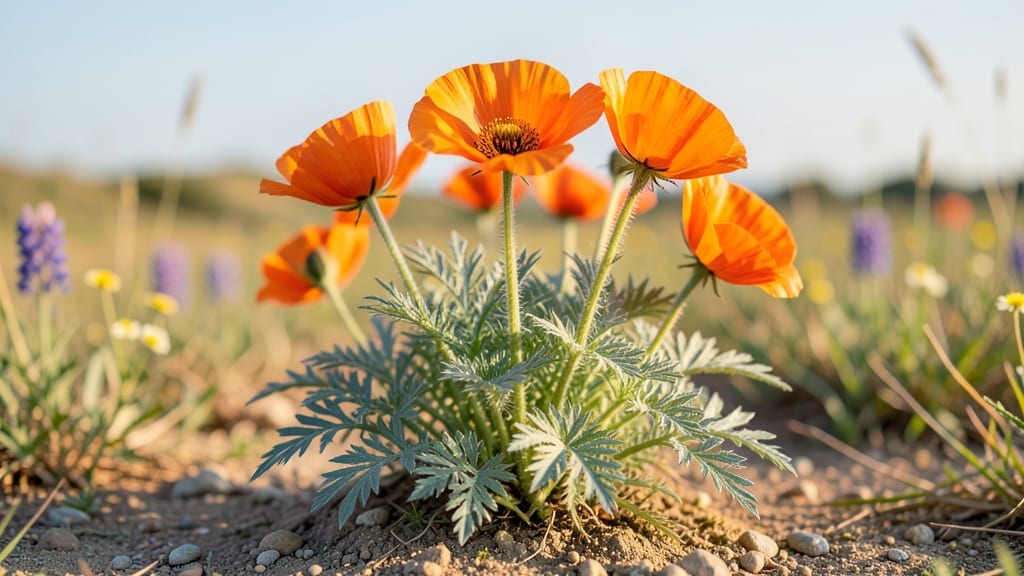
Poppy flowers are not true perennials—they die back annually but often self-seed prolifically, returning each season with fresh growth from new seedlings rather than persistent roots.
While poppies may seem to come back reliably each year, their life cycle is actually annual rather than perennial. 🌱 The key lies in their deep taproots and aggressive seed production—when the plant dies back in late summer or fall, it drops thousands of seeds that lie dormant until conditions are perfect for germination.
This natural reseeding behavior gives the illusion of perennial growth, but it's actually a new generation sprouting from scratch each season.
What this means for gardeners is that poppies thrive with minimal intervention. Unlike true perennials that regrow from established roots, poppies need well-drained soil and full sun to set seed properly. I've found that letting the seed pods mature fully on the plant—even after blooms fade—maximizes next year's volunteers.
The trade-off? You'll get a fresh crop of plants each year rather than the same established clump.
💡 In This Article
- Why Poppies Appear Annual Despite Their Lifespan
- How to Encourage Poppies to Return Year After Year
Why poppies appear annual despite their lifespan
The secret behind poppies' "perennial" behavior lies in their deep taproot system, which can extend 3-4 feet into the soil. Unlike shallow-rooted annuals, this robust structure allows them to store nutrients and moisture during their single growing season.
However, the roots themselves don't survive winter—the entire plant dies back after flowering and seed production. 🌱 What makes them appear perennial is their ability to produce 10,000-20,000 seeds per plant, which scatter and remain dormant until conditions align for germination.
Seed dormancy is another critical factor. Poppy seeds require specific triggers to break dormancy—typically cold stratification (exposure to cold temperatures) followed by warm, moist soil. This two-phase process explains why you might see poppies emerge sporadically over several years after initial planting.
The seeds can remain viable in the soil for 3-5 years, waiting for the perfect moment to sprout. This natural timing mechanism ensures poppies colonize open spaces reliably, even without human intervention.
Botanists classify poppies as therophytes—plants that complete their entire life cycle in a single growing season but leave behind seeds that ensure their persistence. The key difference from true perennials is that poppies don't regrow from the same root system.
Instead, they rely on this seed bank strategy, which is far more energy-efficient for plants in unpredictable climates. 💫 This explains why you might have a dense poppy patch one year that seems to vanish the next—it's not the same plants returning, but their offspring taking over.
Consider the California poppy (Eschscholzia californica) as a prime example. In its native habitat, it thrives in coastal areas where winters are mild but summers are hot and dry.
The deep taproot allows it to access groundwater during droughts, while the seed production ensures the species survives even if individual plants don't. This dual strategy gives poppies the resilience of perennials without the biological commitment to long-term root systems.
What most gardeners don't realize is that this reseeding behavior is actually a survival adaptation. Poppies evolved to prioritize seed production over vegetative growth because their delicate stems can't support large, woody structures like true perennials.
Instead, they invest all their energy into creating as many seeds as possible during their brief lifespan. 🌿 This explains why poppies often appear in disturbed soils or poor-quality gardens—they're opportunistic colonizers that take advantage of any available space.
The trade-off is that each "generation" of poppies is genetically distinct from the previous one. Unlike true perennials that maintain the same genetic line through root division, poppy populations evolve over time as only the most adaptable seeds survive to germinate.
This genetic diversity is what allows poppies to thrive across such wide geographic ranges and soil conditions.