
Flowers
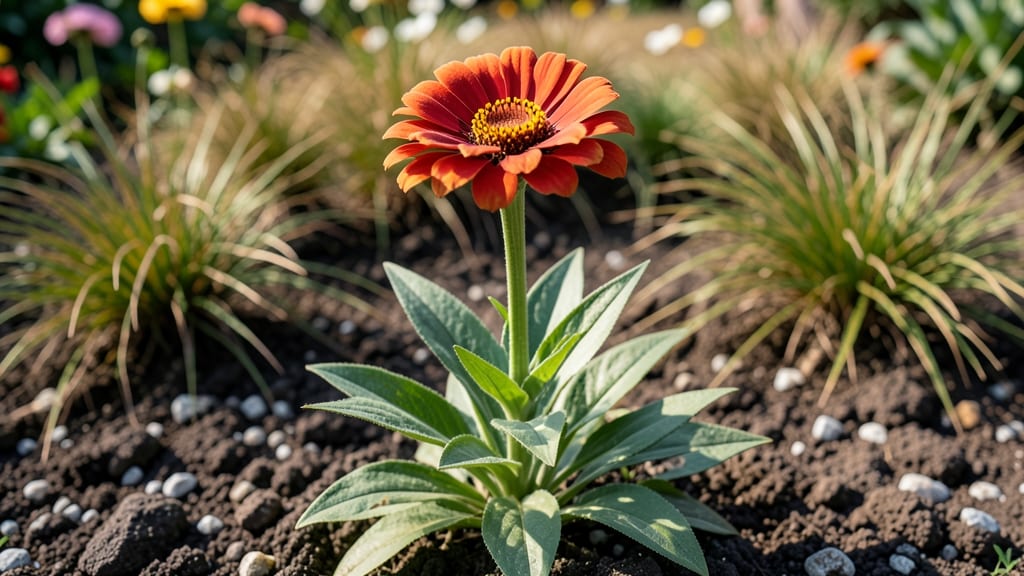
Whether zinnia flowers are annuals or perennials depends on your climate: they complete their lifecycle in one season in most regions, but cold-hardy varieties can survive mild winters as tender perennials in frost-free zones.
Most zinnia varieties thrive as annuals because they can't tolerate frost, which kills their tender stems and leaves. 🌱 However, some newer hybrids—like 'Benary's Giant' or 'Profusion' series—have shown surprising resilience in zones 8-11, where they may regrow from roots if protected.
The key difference lies in their root systems: true perennials store energy underground, while zinnia's shallow roots struggle to survive freezing temperatures.
For gardeners in warmer climates, extending zinnia's lifespan is possible with strategic planning. Planting in containers lets you move them indoors before cold snaps, while heavy mulching insulates roots.
I've even seen zinnia volunteers pop up in spring after overwintering in protected microclimates—proof that with the right care, these cheerful blooms can defy their typical annual classification.
💡 In This Article
- Why Zinnia Flowers Die Back in Winter
- Extending Zinnia Lifespan with Cold-Resistant Gardening Hacks
Why zinnia flowers die back in winter
Zinnia flowers behave as annuals in most climates because their tender stems and leaves can't withstand temperatures below 28°F. When frost hits, the plant's cells rupture due to ice crystal formation, which triggers rapid tissue death.
This is a fundamental difference from true perennials like coneflowers, whose thick, woody roots store carbohydrates to regrow each spring. Zinnia's shallow root system—typically only 6-12 inches deep—lacks the energy reserves to survive winter dormancy.
The botanical mechanism involves a process called "freeze dehydration." As temperatures drop, water inside zinnia cells expands and crystallizes, damaging cell membranes.
Unlike hardy perennials that produce insulating bark or deep root systems, zinnia's growth habit prioritizes rapid above-ground blooming rather than underground storage. 🌬️ Even in frost-free zones, zinnia's natural lifecycle is programmed to complete within 90-120 days, after which the plant naturally senesces (ages) and dies back.
Comparing zinnia to black-eyed Susan (Rudbeckia), a true perennial, highlights the difference: while both thrive in full sun, Rudbeckia's taproot can extend 3-4 feet deep, storing enough nutrients to regenerate each year. Zinnia's fibrous roots, by contrast, spread horizontally but offer no winter protection.
This structural limitation explains why zinnia's annual classification holds true in USDA zones 3-7, where winters regularly drop below freezing.
What makes this even more interesting is how zinnia's growth patterns adapt to seasonal cues. Photoperiodism—the plant's response to daylight length—triggers flowering in late spring/early summer, but the same mechanism doesn't prepare it for winter survival.
Unlike biennials that store energy for a second year, zinnia's entire energy focus goes toward seed production before frost arrives. This biological trade-off explains why gardeners in colder regions must replant zinnia each spring.
For those in transition zones (like zone 8), the difference between annual and perennial behavior becomes a matter of degrees. A single 20°F night can kill back zinnia, while a milder winter might allow roots to persist.
This is why some gardeners report "volunteer" zinnia plants appearing in spring—the few surviving roots have enough vitality to regrow, though they rarely match the vigor of true perennials.
The key takeaway is that zinnia's annual nature isn't a flaw—it's an evolutionary adaptation for warm-season blooming. Its rapid growth cycle maximizes flower production in a short window, making it a favorite for cut flowers and pollinator gardens.
But this same trait makes winter survival nearly impossible without human intervention. 💫