
Plants
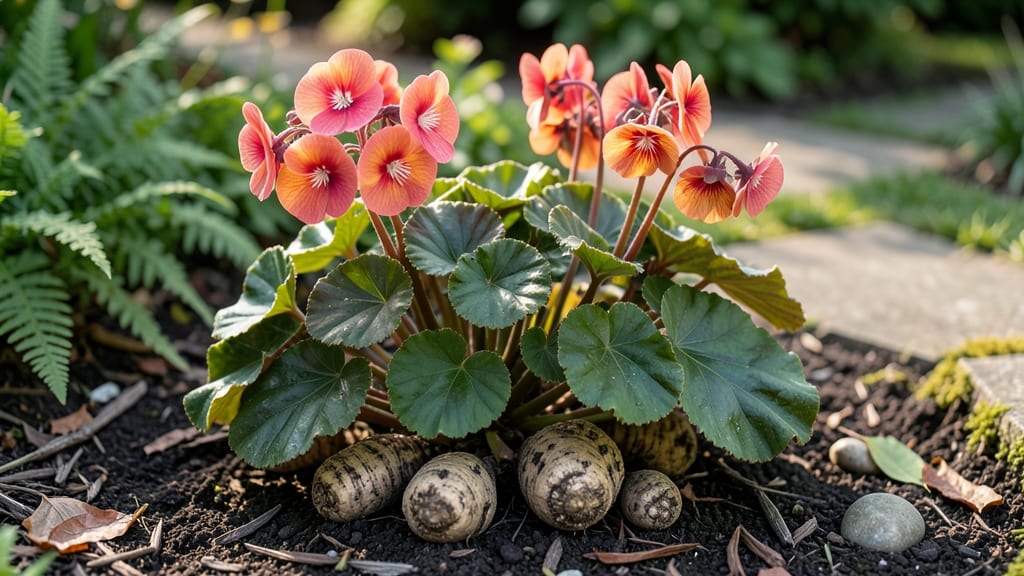
Tuberous begonias are not perennials in cold climates—their fleshy tubers die back annually when frost hits, requiring winter storage to survive. In frost-free zones (USDA 10-11), they behave like perennials, regrowing from tubers each season.
Tuberous begonias confuse many gardeners because their behavior depends entirely on climate.
In warmer regions (like Florida or Southern California), these plants naturally return year after year—true perennial behavior—because their tubers stay dormant but viable through mild winters. 🌱 However, in colder zones (USDA 8 and below), frost triggers complete dormancy, forcing gardeners to dig up and store tubers indoors until spring.
The key difference lies in how temperature affects tuber dormancy: in cold climates, the tubers simply can't survive the freeze-thaw cycle without human intervention.
This isn't just about survival—it's about timing. Tubers need consistent warmth (above 50°F) to break dormancy in spring. In frost-free areas, nature handles this automatically, while gardeners in colder regions must mimic these conditions with proper storage techniques.
The good news? With the right care, even cold-climate growers can enjoy these stunning flowers year after year.
💡 In This Article
- Why Tuberous Begonias Act Like Perennials in Warm Climates
- How to Overwinter Tuberous Begonia Tubers for Next Year
Why tuberous begonias act like perennials in warm climates
Tuberous begonias thrive as perennials in frost-free zones because their biological survival mechanism relies on temperature cues. In USDA zones 10-11, where winters rarely drop below 40°F, the tubers experience only mild dormancy rather than complete freeze-induced death.
The plant's natural cycle involves storing nutrients in its swollen underground tubers during cooler months, then resuming growth when temperatures consistently rise above 55°F in spring. This process mirrors true perennials, but with a critical difference: tuberous begonias lack cold-hardy root systems that can withstand freezing.
The key lies in the tuber's cellular structure. Unlike woody perennials that develop protective layers against frost, tuberous begonia tubers contain high moisture content (about 70-80% water) that freezes and ruptures cell walls when exposed to temperatures below 32°F.
In warm climates, the tubers remain just dormant—not dead—allowing them to regenerate foliage within 4-6 weeks of warm weather. This explains why they bloom reliably each season without gardener intervention, while their cold-climate counterparts require careful storage.
Consider Florida's climate as a perfect example. Here, tuberous begonias naturally emerge in early spring when soil temperatures reach 60°F, producing vibrant blooms that last until first frost—typically October. The plant's growth cycle synchronizes perfectly with the region's 12-month growing season, eliminating the need for overwintering.
This perpetual cycle creates the illusion of true perennial behavior, when in reality, it's just an absence of frost that preserves the tuber's viability.
Botanists classify tuberous begonias as "geophytes"—plants that store nutrients underground during adverse conditions. What makes them unique is their thermally-sensitive dormancy: cold triggers dormancy in northern climates, while warm winters maintain just enough metabolic activity to keep tubers alive.
This explains why gardeners in zone 9 sometimes see spontaneous regrowth—partial dormancy occurs, but not complete death. The line between perennial behavior and survival-of-convenience blurs when frost never arrives.
Here's what happens at the cellular level: tuber cells produce protective proteins when exposed to 45-50°F temperatures, similar to how some vegetables develop sweetness in cold. But when frost hits, these proteins can't prevent ice crystal formation in the tuber's water-rich tissues.
The result? Cell damage that's irreversible without proper storage. In warm climates, this protective mechanism never activates fully, allowing the tuber to remain in a state of suspended animation until growing conditions return.
For visual learners, imagine a potato left in the ground during winter. In zone 10, it might sprout next spring; in zone 5, it'll rot. Tuberous begonias follow the same principle but with more delicate tissue.
The difference is that begonia tubers contain less starch** and more water—making them far more vulnerable to freeze damage. This biological fragility is why they've evolved to thrive only where frost is absent.
What this means for gardeners: if you live in a warm climate, your tuberous begonias will indeed act like perennials—no digging required. But if you're in zone 8 or colder, you're dealing with a plant that's biologically incapable of surviving winter outdoors.
The "perennial" label is a climate-dependent illusion, not a botanical fact. 🌿