
Orchid Care
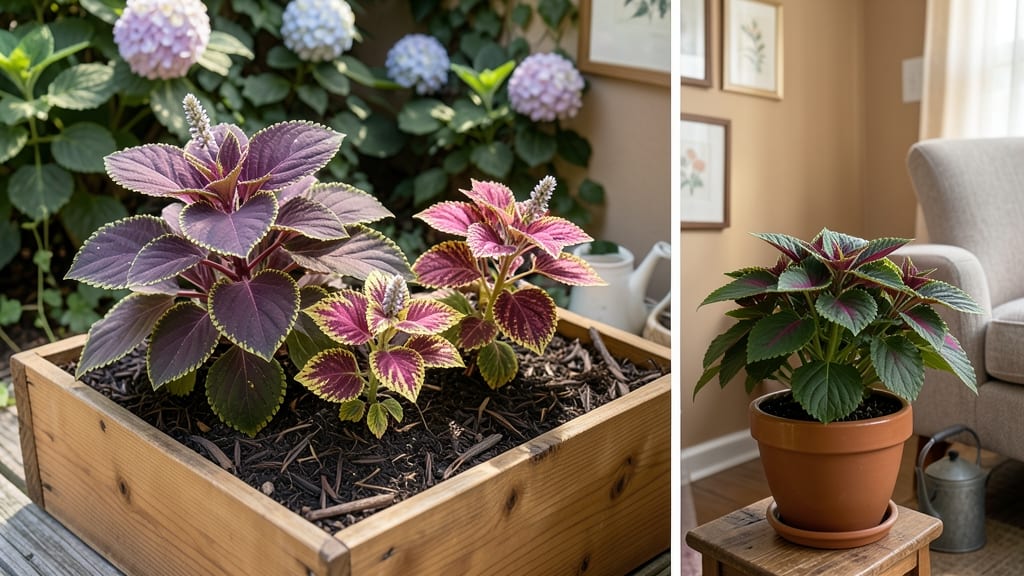
Whether coleus is annual or perennial depends on your climate: it thrives as a perennial in warm USDA zones 10-12, where it naturally regrows from roots after winter dormancy, but must be treated as an annual in colder regions. Your growing approach—like taking cuttings or overwintering indoors—can extend its lifespan beyond a single season.
This distinction comes down to temperature tolerance and root resilience. 🌱 In frost-free zones, coleus plants enter a dormant state during cooler months but their roots survive underground, ready to sprout fresh foliage when warmth returns.
In colder areas, however, the entire plant typically dies back when temperatures drop, requiring gardeners to propagate new plants each spring from cuttings or seeds. The key difference is that perennial coleus leverages its underground storage system, while annual coleus relies entirely on human intervention to continue its lifecycle.
For gardeners in transitional zones (like USDA zone 9), the line gets blurrier—some coleus varieties may survive mild winters if protected, while others won't. That's why I always recommend testing your local microclimate first: try overwintering a few plants in containers near a south-facing wall, where they might just pull through the cold months.
The right propagation technique can turn what appears to be an annual into a multi-year houseplant or garden staple.
💡 In This Article
- Understanding Coleus Dieback and Regrowth Patterns
- Extending Coleus Lifespan Through Propagation
Understanding coleus dieback and regrowth patterns
The coleus plant's annual or perennial nature hinges on its biological response to temperature shifts. In USDA zones 10-12, where winter temperatures rarely drop below 40°F, coleus enters a natural dormancy cycle. This isn't true hibernation—rather, the plant conserves energy by slowing growth while maintaining viable roots underground.
The fibrous root system, which can extend 12-18 inches deep, stores carbohydrates that fuel regrowth when temperatures rise above 60°F again. 🌿 This root survival mechanism is what transforms coleus into a perennial in warm climates.
In colder regions, however, the plant's sensitivity to frost becomes the defining factor. Coleus stems contain 50-60% water by weight, which freezes at 32°F and causes cellular damage through ice crystal formation.
When nighttime temperatures dip below 35°F for extended periods, the entire above-ground plant will die back—leaving only the roots vulnerable.
The key difference is that perennial coleus roots can withstand these conditions because they're insulated by soil and organic matter, while annual coleus simply lacks this protective environment in colder climates.
Seasonal light exposure also plays a crucial role in this cycle. Coleus is a short-day plant, meaning it responds to decreasing daylight hours (below 12 hours) by preparing for dormancy. This photoperiod sensitivity triggers the plant to shift resources from leaf production to root storage.
In warm climates, this transition is temporary—roots remain active enough to sustain the plant through winter. But in colder regions, the combination of frost and reduced daylight accelerates the dieback process, making annual growth the only viable option.
What most gardeners don't realize is how microclimates can create exceptions to these rules. Even in zone 7 or 8, a coleus planted in a sheltered spot—like near a south-facing foundation or under eaves—might survive winters if protected by 3-4 inches of mulch.
The mulch acts as insulation, maintaining soil temperatures above 35°F even when air temperatures drop. This creates a localized perennial environment within what would otherwise be annual growing conditions.
Variety also matters significantly. Some coleus cultivars, like the 'Black Dragon' series, have thicker stems and darker foliage that may handle cooler temperatures slightly better than delicate varieties like 'Wine and Roses'.
The pigmentation in dark-leafed coleus actually helps absorb more solar radiation during winter, providing a small thermal advantage. However, this doesn't change the fundamental biological response to frost—only extends the range by 2-3°F at most.
Understanding these patterns helps explain why some gardeners in transitional zones report "perennial" coleus while others don't. The difference often comes down to specific winter conditions rather than the general climate zone classification.
For example, a particularly mild winter in zone 8 might allow coleus to survive when a harsh freeze in zone 9 wouldn't. This variability is why propagation techniques become so important for extending coleus lifespan beyond its natural growing season. 💫