
Flowers
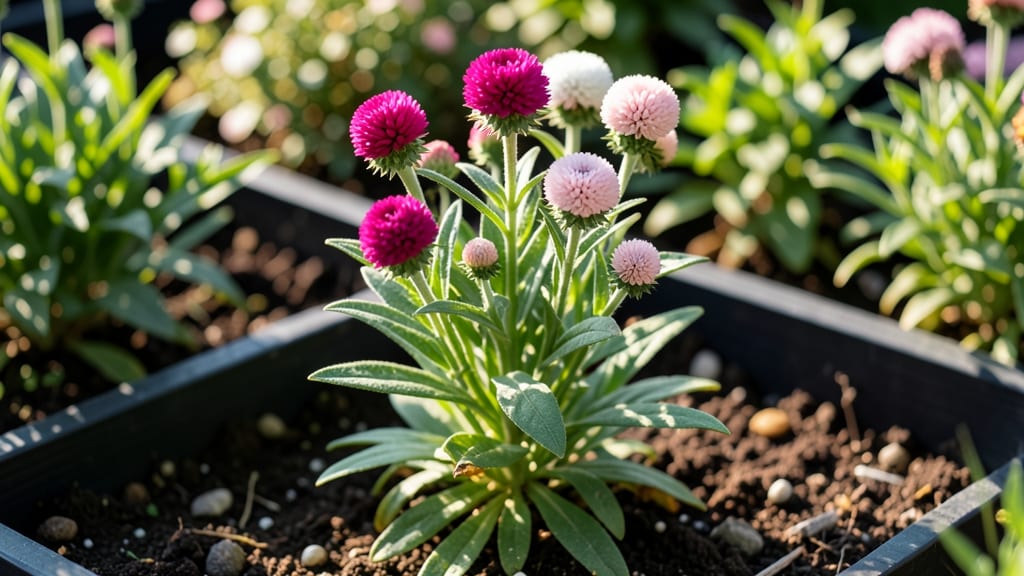
Gomphrena behaves like a perennial in warm climates but acts as an annual in colder regions, since it dies back to the ground in winter unless protected from hard freezes. In zones USDA 9-11, it thrives year-round as a self-seeding groundcover.
Gomphrena's survival depends heavily on your hardiness zone. 🌱 In colder climates (USDA 5-8), it typically dies back completely each winter, only to regrow from seeds the following spring. However, if you protect the roots with thick mulch or overwinter it in containers, you might coax it back.
The key is understanding its frost sensitivity—even a light freeze can kill above-ground growth, but the root system often survives to regenerate. In milder zones, it naturally returns year after year, rewarding gardeners with vibrant blooms season after season.
What's fascinating is how this plant adapts: in warmer regions, gomphrena spreads aggressively through self-seeding, creating lush groundcover. Meanwhile, in colder areas, gardeners often treat it as an annual despite its perennial tendencies.
The difference comes down to winter protection—whether through mulch, containers, or strategic planting depth to shield roots from freezing temperatures.
💡 In This Article
- Gomphrena’s Perennial Behavior in Different Climates
- Extending Gomphrena’s Lifespan: Mulching and Overwintering Tips
Gomphrena’s perennial behavior in different climates
Gomphrena’s survival strategy hinges on its root system, which stores energy to regrow after winter dormancy. In warmer zones (USDA 9-11), it behaves like a true perennial, with roots surviving 10-15°F temperatures and even light freezes.
The plant’s deep taproots (reaching 12-18 inches deep) anchor it firmly, allowing it to access moisture and nutrients year-round. This explains why it thrives as a self-seeding groundcover in Southern California or Florida—its roots stay active, and new shoots emerge naturally each spring. 🌿
In colder climates (USDA 5-8), the above-ground growth dies back completely when temperatures drop below 25°F, but the roots often persist. The key difference lies in frost sensitivity: gomphrena’s leaves and stems contain moisture that freezes and ruptures cell walls, causing wilting.
However, the root crown—where new growth originates—remains dormant but viable if protected. Think of it like a bulb: the visible plant dies, but the underground energy reserve stays alive. This is why gardeners in Zone 6 might see gomphrena return if they mulch heavily or use frost blankets.
What most gardeners overlook is the plant’s self-seeding habit, which acts as a backup survival mechanism. Even if the roots don’t regrow, gomphrena drops thousands of tiny seeds that germinate in spring. These seeds can remain viable in the soil for 2-3 years, ensuring continuity.
In milder winters (USDA 8-9), this dual strategy—root survival + seed germination—makes gomphrena appear perennial even when technically it’s not. The confusion arises because its behavior blends annual and perennial traits depending on climate.
The science behind this involves cold acclimation, a process where plants adjust their metabolism to tolerate freezing. Gomphrena produces protective proteins and sugars in its roots that act like antifreeze, lowering the freezing point of its cells.
However, this adaptation has limits: prolonged exposure to -5°F or below will kill even the roots. That’s why gardeners in Zone 5 often treat it as an annual—it’s a gamble whether the roots will survive harsh winters. 🌡️
Consider this comparison: in Zone 10, gomphrena grows as a shrub-like perennial, reaching 2-3 feet tall with woody stems. In Zone 6, it’s more like a short-lived perennial, growing 1-2 feet tall and dying back annually unless protected.
The transition between these behaviors happens gradually across zones, with Zone 7 being the tipping point where some plants survive winters while others don’t. This variability is what makes gomphrena so adaptable—and why gardeners must tailor their care approach.