
Flowers
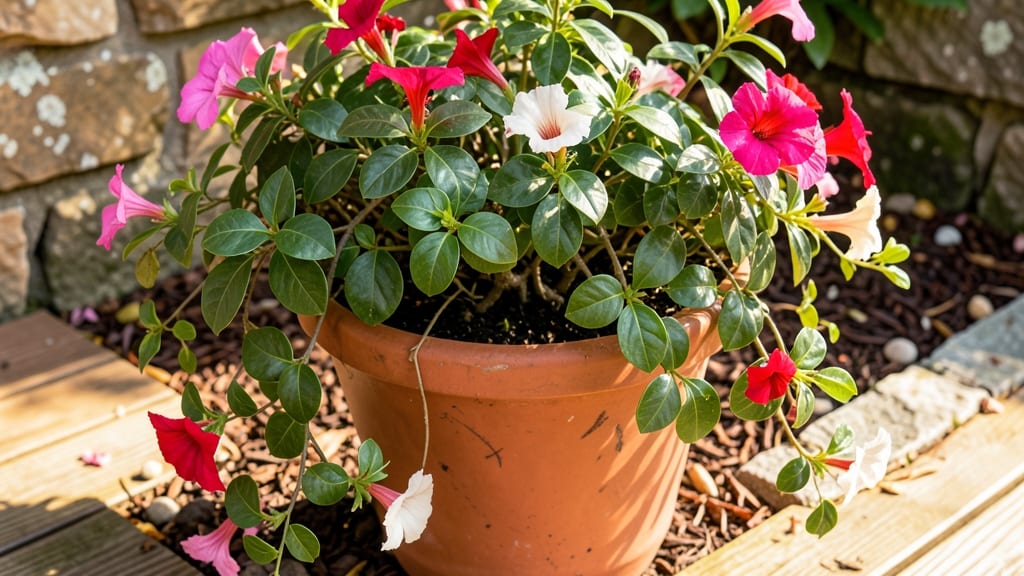
Vining Mandevilla isn't a true perennial in colder climates, as it dies back to the ground when temperatures fall below 30°F (-1°C). Instead, it functions as a tender perennial in USDA zones 9-11, where it can survive winters without protection.
This tropical vine behaves like a seasonal plant in frost-prone areas, where it requires special care to return each year. 🌱 Unlike hardy perennials that endure freezing temperatures, Mandevilla's delicate nature means gardeners in zones 7 and below must either dig up containers or provide heavy mulch to shield roots.
The key difference lies in its origin—native to South America's warm climates, this vine simply can't tolerate prolonged cold exposure.
What makes this interesting is how gardeners adapt: some overwinter potted plants indoors, while others use thick mulch layers to simulate container insulation.
The plant's ability to regrow from dormant tubers each spring demonstrates its resilience when given proper protection, making it possible to enjoy its stunning blooms year after year even in cooler regions.
💡 In This Article
- How Cold Tolerance Defines Mandevilla’s Perennial Status
- Winter Survival Strategies for Mandevilla Vines
How cold tolerance defines Mandevilla’s perennial status
Mandevilla's classification as a tender perennial stems from its tropical origins in South America, where temperatures rarely dip below 50°F (10°C). Unlike hardy perennials such as lavender or hydrangeas—which can survive -20°F (-29°C) or colder—Mandevilla's cells lack the antifreeze proteins that protect other plants from ice crystal formation.
When exposed to 30°F (-1°C) or lower, its leaves blacken and stems die back, but the root system often remains dormant beneath the soil.
The key difference lies in its cold acclimation process. True perennials gradually harden off as temperatures drop, building up protective sugars and proteins. Mandevilla, however, has no such mechanism—its metabolic processes shut down abruptly when chilled.
This is why gardeners in USDA zones 9-11 can treat it as a perennial, while those in colder zones must intervene annually. 🌡️ For example, a zone 10 Mandevilla might handle a brief 28°F (-2°C) dip with minimal damage, but a zone 7 plant would suffer severe frost damage.
Botanically, Mandevilla belongs to the Apocynaceae family, which includes other frost-sensitive plants like oleander and frangipani. These species share a common trait: they prioritize rapid growth and flowering over cold resistance.
The trade-off is stunning 5-inch (12.5 cm) trumpet-shaped blooms in vibrant pinks, whites, and reds—but at the cost of winter hardiness. In contrast, hardy perennials like Russian sage can withstand -30°F (-34°C) by producing protective compounds that prevent cellular damage.
What makes Mandevilla unique is its tuberous root system, which allows it to regenerate each spring from dormant buds. This adaptation explains why many gardeners successfully overwinter it despite its tender status.
The roots store starches that fuel regrowth when temperatures warm to 60°F (15°C) or above. Without this mechanism, Mandevilla would behave more like an annual, dying completely each winter.
Consider this comparison: while daylilies (true perennials) can regrow from their crowns after -15°F (-26°C) exposure, Mandevilla's survival depends entirely on protecting its root zone.
This fundamental difference in cold tolerance is why gardeners in zone 8 might lose their vines without 12+ inches (30 cm) of mulch**, while zone 9 gardeners can leave them in the ground with minimal protection.
Understanding these biological limits helps explain why Mandevilla thrives in Florida's subtropical climate but struggles in New York's continental winters.
The plant's inability to harden off means its perennial status is conditional—it's only truly perennial in frost-free zones. 🌿 This is why container cultivation becomes essential for northern gardeners: pots can be moved indoors or insulated to maintain root-zone temperatures above 40°F (4°C).