
Flowers
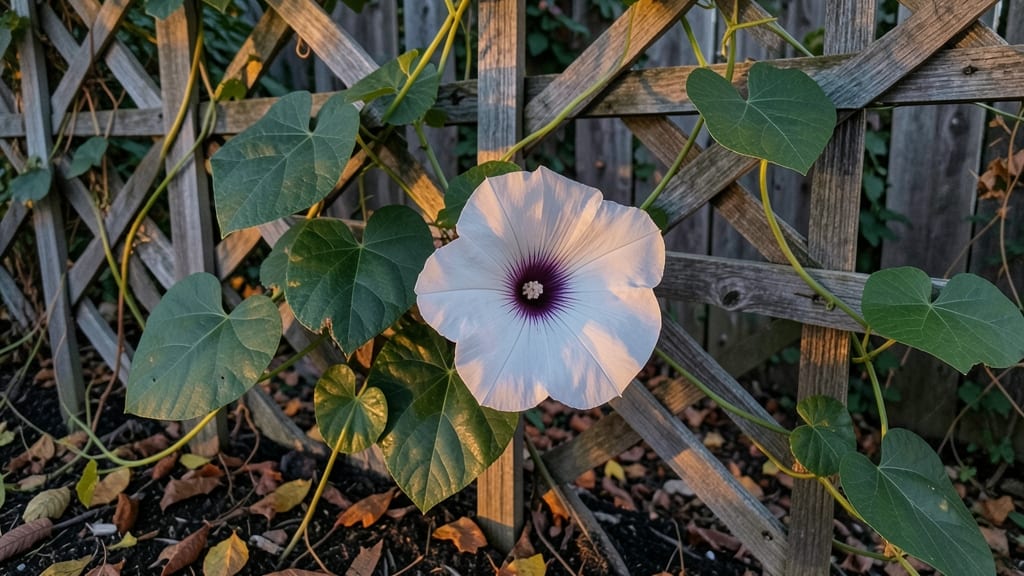
Moonflowers are not true perennials—they die back annually after blooming, though their roots persist in mild climates, allowing regrowth each spring under ideal conditions. They thrive as tender annuals in most regions.
Moonflowers (Ipomoea alba) behave like tender annuals in most climates, meaning they complete their life cycle in one growing season but can sometimes return if their roots survive winter. 🌙 The key difference from true perennials lies in their cold sensitivity—while their roots may endure mild winters, freezing temperatures typically kill them back.
In warmer zones (USDA 9-11), they often regrow from the same roots year after year, creating the illusion of perennial behavior. This makes them perfect for gardeners who want dramatic summer blooms without long-term commitment.
Their dieback cycle is what makes them unique—after a spectacular summer of fragrant white blooms, the vines wither completely by fall. However, if you live in a frost-free area or provide winter protection (like mulch), those roots can wait patiently underground until spring's warmth signals new growth.
This adaptability is why many gardeners treat them as both annuals and perennials depending on their local climate.
💡 In This Article
- Moonflower Lifespan: Annual vs. Perennial Behavior Explained
- Extending Moonflower Growth: Planting and Care Tips
Moonflower lifespan: annual vs. perennial behavior explained
Moonflowers (Ipomoea alba) occupy a fascinating botanical gray area—they're classified as short-lived perennials in their native tropical and subtropical regions, but behave more like tender annuals in most temperate climates.
The distinction comes down to their root system, which can persist for multiple years in frost-free zones (USDA 9-11) but typically dies back completely in colder areas.
Their thick, tuberous roots store energy like true perennials, allowing regrowth when conditions improve, but they lack the cold-hardy resilience of plants like peonies or hostas.
Their dieback cycle follows a predictable pattern: vigorous growth in spring, explosive flowering from summer to early fall, then complete senescence by frost. What sets them apart is their ability to re-sprout from the same root system if winter temperatures stay above 20°F (-6°C).
In warmer climates, this creates a multi-year cycle where the same plant may return for 3-5 years before finally declining.
The roots can even produce multiple shoots in a single season, creating dense mounds of growth. 🌱 This explains why some gardeners swear their moonflowers "come back every year"—they're technically doing the same thing, just with fresh growth from dormant roots.
Climate plays the biggest role in determining their behavior. In Zone 8 and below, moonflowers act like true annuals, completing their lifecycle in one season. The roots simply don't survive freezing temperatures. But in Zones 9-11, they often return year after year because the roots remain viable.
This adaptability makes them perfect for gardeners who want perennial-like performance without the long-term commitment. The key difference from true perennials is their lack of winter hardiness—while their roots may persist, they don't develop the same level of cold resistance as native perennials.
Here's what's actually happening at the cellular level: Moonflower roots contain specialized parenchyma cells that store starches and sugars during the growing season. When temperatures drop but stay above freezing, these cells enter a dormant state rather than dying completely.
The moment soil temperatures rise above 60°F (15°C) in spring, hormonal signals trigger new shoot growth from these stored reserves. This is why you'll often see moonflowers emerge earlier than many other plants—their roots are already primed and ready to grow.
What most gardeners don't realize is that moonflowers have a built-in survival mechanism for their tropical origins. In the wild, they grow as vines along forest edges where they experience seasonal dry periods rather than freezing temperatures.
This explains why they handle drought conditions better than cold snaps—their roots can remain dormant for months without water, but won't survive prolonged freezing.
The trade-off is their spectacular summer performance: they devote all their energy to rapid growth and flowering during their active season, then conserve resources when conditions turn unfavorable.
Consider this comparison: A true perennial like black-eyed Susan will survive -20°F (-29°C) winters with minimal protection, while moonflowers will die back completely at 15°F (-9°C) unless heavily mulched.
Yet in ideal conditions, those persistent roots can produce 3-5 times more growth than a first-year plant, making them more productive than many true annuals over multiple seasons. This dual nature is what makes moonflowers so rewarding for patient gardeners willing to adapt their care strategies to local conditions. ✨