
Orchid Care
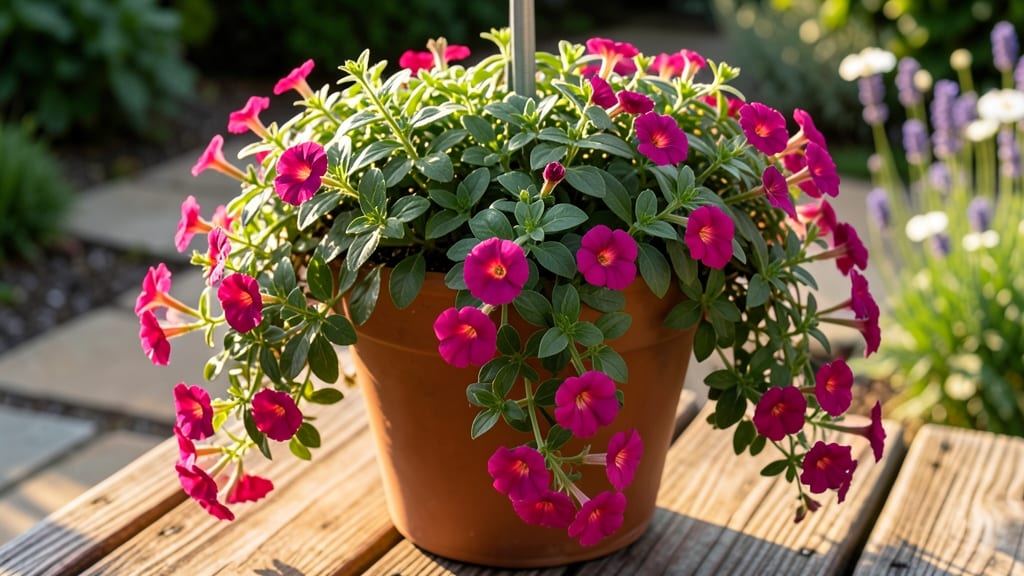
Whether Calibrachoa SuperBells act as annuals or perennials depends entirely on your climate: they die back when temperatures drop below 40°F (4°C), so most gardeners treat them as annuals. Only in USDA Zones 9-11 can they survive winter with proper protection like mulch or frost blankets.
These vibrant trailing plants thrive as summer favorites but lack the winter hardiness of true perennials. 🌱 The key difference lies in their cellular structure—unlike cold-resistant perennials, SuperBells' delicate foliage freezes at 32°F (0°C), making them vulnerable even to light frosts.
In colder regions, gardeners often replant new starts each spring, while Zone 9-11 growers can extend their lifespan with winter mulching or container protection. The trade-off? Their annual treatment yields nonstop blooms all season long.
For those outside frost-free zones, strategic planting can create the illusion of perennial growth. Try succession planting every 6-8 weeks or grow them in containers that can be moved indoors during winter.
Some cold-tolerant varieties like 'SuperBells Frosty' handle 35°F (2°C) better, but even these won't survive prolonged freezing. The good news? Their fast growth means you'll always have colorful cascades to enjoy.
💡 In This Article
- Understanding Calibrachoa SuperBells Cold Hardiness Limits
- Year-Round Calibrachoa SuperBells: Growing Strategies for Cold Climates
Understanding Calibrachoa SuperBells cold hardiness limits
Calibrachoa SuperBells' cold sensitivity stems from their tropical origins—these plants evolved in South America's warm climates where temperatures rarely dip below 50°F (10°C). Their cells lack the protective mechanisms of hardy perennials, like antifreeze proteins or thick bark insulation.
When exposed to 32°F (0°C), ice crystals form within their thin, waxy leaves, rupturing cell walls and causing irreversible damage. This is why even a light frost triggers dieback, unlike cold-hardy perennials that enter dormancy.
The USDA hardiness zone system helps explain why SuperBells thrive as annuals in most regions. Zones 9-11 (average minimum 20°F/-7°C) offer mild winters where these plants can persist with protection, while zones 3-8 (down to -40°F/-40°C) see lethal freezes.
The 40°F (4°C) threshold isn't just arbitrary—it's the point where metabolic processes slow dangerously, and the plant's natural antifreeze compounds (like proline amino acids) become insufficient to protect cellular structures.
What most gardeners don't realize is how quickly cold damage occurs. SuperBells show visible frost damage within 1-2 hours of exposure to 32°F (0°C)
This explains why even a single overnight frost can kill established plants—there's no gradual acclimation period like with cold-hardy annuals such as pansies. For comparison, consider how petunias (another trailing plant) handle cold: they survive down to 28°F (-2°C) with some protection, while SuperBells lack this resilience. Their lack of winter dormancy means they can't conserve energy like true perennials. Instead, they pour resources into continuous blooming during warm months, leaving them vulnerable when temperatures drop. Here's the science behind their annual treatment: SuperBells' growth cycle is tied to warm-season photosynthesis. When nights stay above 50°F (10°C) consistently, they produce flowers nonstop. But as days shorten and temps fall, their chlorophyll breaks down (senescence), and they can't recover—unlike perennials that store energy in roots for spring regrowth. 🌡️ In frost-free zones, gardeners can extend their lifespan by mimicking tropical conditions: use 3-4 inches (7-10 cm) of mulch to insulate roots and cover plants with frost blankets during rare cold snaps. Even then, they'll need spring replanting, as their cellular memory doesn't adapt to seasonal changes like true perennials do.