
Orchid Care
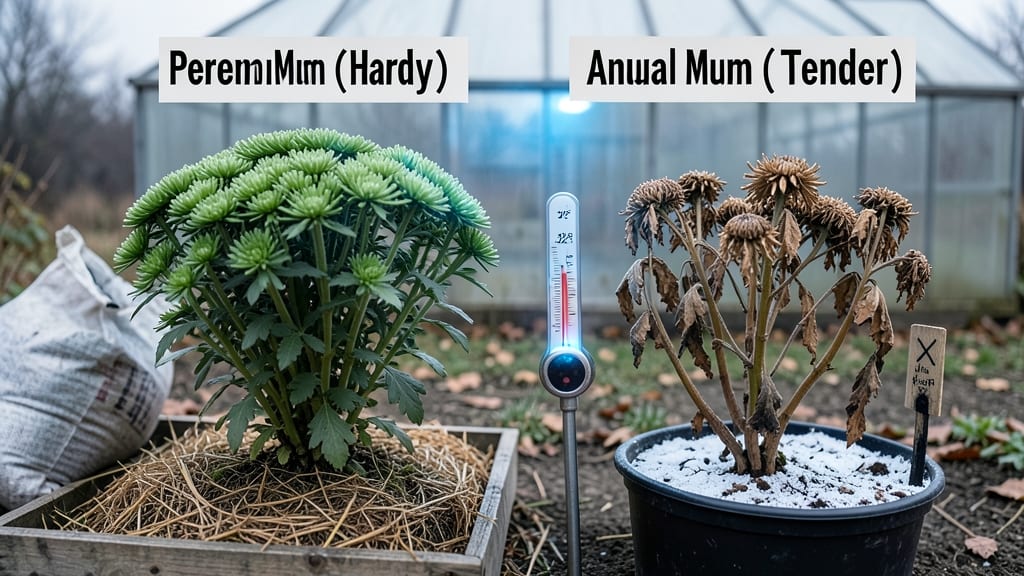
Whether mums (chrysanthemums) are annuals or perennials for winter depends on your climate: they thrive as perennials in USDA Zones 5-9 but often die back in colder areas, requiring replanting each year for consistent blooms.
This difference comes down to how well mums handle frost. In warmer zones, their roots survive winter dormancy, sending up fresh growth in spring. 🌱 However, in colder regions, gardeners often treat them as annuals because the above-ground stems freeze, though the roots may linger—sometimes resprouting if conditions are right.
I’ve seen this firsthand in Zone 4 gardens where mums return unpredictably after mild winters, but replanting guarantees reliable fall color.
For those in frost-prone areas, the key is protecting the roots with thick mulch or overwintering potted mums in unheated garages. This small effort can turn a one-season annual into a reliable perennial that blooms year after year.
The choice between annual and perennial treatment really boils down to how much effort you’re willing to invest in winter care versus the convenience of fresh plants each spring.
💡 In This Article
- Chrysanthemum Hardiness Zones and Winter Survival
- Protecting Mums Through Winter for Repeat Blooms
Chrysanthemum hardiness zones and winter survival
Chrysanthemums (mums) are classified as perennials in USDA Zones 5-9 because their root systems can survive winter dormancy when properly protected. The key difference between their perennial nature and annual treatment lies in how cold they can tolerate.
In Zone 5, for example, mums can endure temperatures down to -20°F when their roots are insulated with 4-6 inches of mulch. The science here involves their growth habit: mums enter dormancy in fall, shedding leaves and stems while storing energy in their roots.
Above-ground dieback is normal in winter, but the roots remain alive below the frost line.
This is why you might see mums resprouting in spring even after a harsh winter—the roots survived! 🌱 In colder zones (like Zone 4 or below), however, the roots often don't survive unprotected, which is why gardeners in these areas replant yearly.
The transition temperature is typically around 25°F, where even hardy mums struggle without insulation.
What most people don't realize is that mums' perennial nature is tied to their natural habitat in East Asia, where winters are cold but not extreme. The species Chrysanthemum morifolium, the most common garden mum, has been selectively bred for cold tolerance, but it still needs protection.
The difference between perennial success and annual treatment often comes down to just 2-3 inches of extra mulch or a simple frost cloth.
Here's what happens in the soil: When temperatures drop below 32°F, the roots enter a state of dormancy, slowing metabolism to conserve energy. This is similar to how bulbs like tulips survive winter.
However, unlike tulips, mums don't have protective scales—their survival depends entirely on soil insulation. In wet climates, this means well-draining soil is crucial to prevent root rot during thaw cycles.
Gardeners in marginal zones (like Zone 5's northern edge) often see a middle ground: mums may survive some winters but not others. This inconsistency is why many opt for annual replanting—it guarantees consistent fall color without the gamble of winter survival.
The trade-off is simple: reliability vs. effort. For those willing to invest in winter protection, mums can reliably return year after year.
Consider this comparison: A well-mulched mum in Zone 5 might survive winters with 90% success rate, while an unprotected one in Zone 4 has less than 10% chance of returning.
The 4-inch mulch rule is your best friend here—it's the difference between a perennial garden staple and an annual treat.