
Flowers
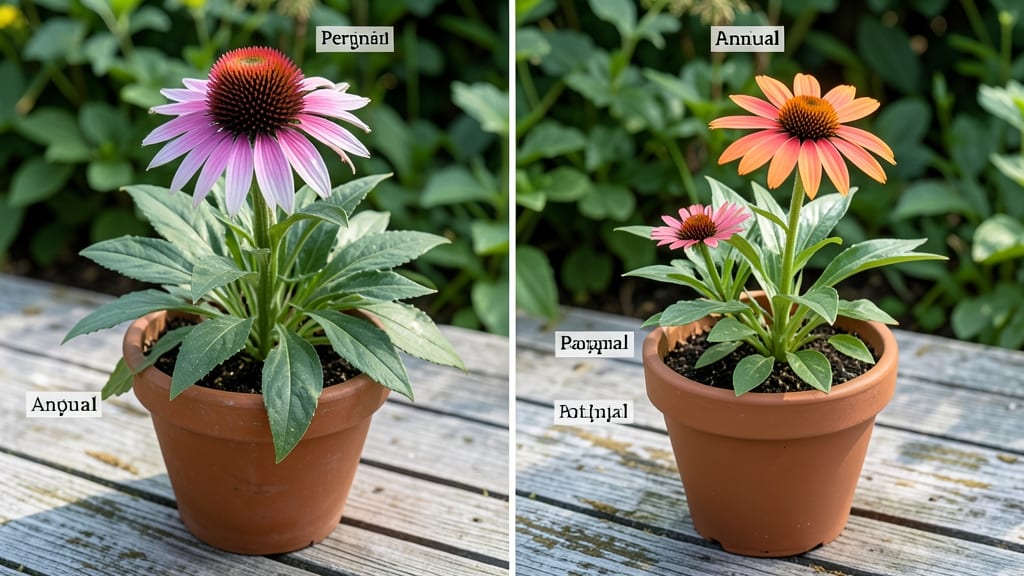
Deciding whether echinacea is annual or perennial depends on your climate: it's a hardy perennial in most regions but may act like an annual in colder zones without winter protection.
Echinacea's perennial nature comes from its deep, fibrous roots that store energy to fuel regrowth each spring. 🌱 In warmer climates (USDA zones 3-9), these roots survive winter dormancy, sending up new stems by early spring.
However, in colder regions or without proper mulching, the plant may appear dead but still has a chance to bounce back if the roots stay intact.
What sets echinacea apart is its ability to self-propagate—many gardeners find new shoots popping up nearby after just one growing season.
This makes it a low-maintenance perennial for most gardeners, though some varieties like 'Magnus' or 'White Swan' may need extra care in harsh winters to maintain their perennial growth habits.
💡 In This Article
- How Echinacea’s Perennial Life Cycle Works
- Tips for Extending Echinacea’s Perennial Growth
How echinacea’s perennial life cycle works
Echinacea's perennial nature relies on its deep, robust root system called a taproot, which can extend up to 2-3 feet underground. Unlike annuals that complete their life cycle in one season, echinacea stores energy in these roots during winter dormancy—similar to how a potato stores nutrients for regrowth.
This root system remains alive even when above-ground foliage dies back in late fall, allowing the plant to push new growth as soon as soil temperatures rise above 50°F in spring. 🌱
The plant's seasonal cycle follows a predictable pattern: it emerges in early spring, blooms through summer, and enters dormancy by late fall when temperatures drop below 40°F.
In USDA zones 3-9, echinacea typically survives winter without issues, but in colder zones (like zone 2), the roots may struggle if not protected. What's fascinating is how the roots can remain viable for 5-7 years or more, making established plants extremely hardy once established.
Cold hardiness plays a critical role in determining whether echinacea behaves as a true perennial. Varieties like 'Green Envy' or 'Hot Papaya' are particularly cold-tolerant, surviving down to -20°F with proper mulching.
However, in extreme cold snaps (below -30°F), even these hardy varieties may suffer root damage, causing them to act more like annuals by not regrowing the following spring. This is why gardeners in colder climates often use thick mulch or row covers as protective measures.
What most gardeners don't realize is that echinacea's dormancy isn't true hibernation—it's an active survival strategy. The roots continue low-level metabolic activity, even in freezing temperatures, to maintain cellular integrity. This process, called cold acclimation, allows the plant to bounce back quickly once conditions improve.
The key difference between echinacea's perennial behavior and true annuals is this root system's ability to regenerate above-ground growth from stored energy reserves. 💫
Another interesting aspect is how echinacea's growth habit changes with age. Young plants (first year) focus all energy on root development, often producing minimal foliage. By the second year, they establish a strong root base and begin flowering, demonstrating their true perennial nature.
This two-year establishment period is crucial for understanding why some gardeners see their echinacea "disappear" in winter—it's not dead, just in its dormant phase waiting for spring's cue.
For those wondering about the visual cues: healthy echinacea roots have a woody texture and often appear brownish when exposed. In contrast, damaged roots may look blackened or mushy, indicating winter kill.
The presence of green shoots emerging from the base in spring is the clearest sign that the perennial cycle is working properly, proving the plant's resilience through its root system. ✨