
Flowers
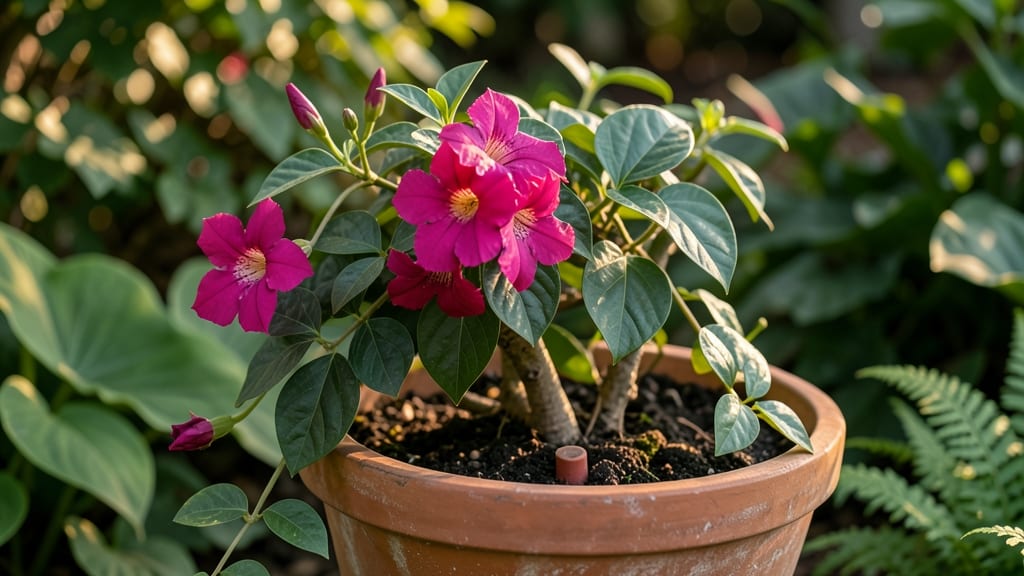
Mandevilla is not a true perennial in cold climates, as it dies back to the ground when temperatures drop below 30°F (-1°C), requiring annual replanting or winter protection in USDA zones 9-11. In warmer zones, it behaves like a perennial with proper care.
Mandevilla's tropical origins explain why it struggles in colder regions—its roots and stems can't survive freezing temperatures. 🌱 While it thrives as a perennial in frost-free zones (like Florida or Southern California), gardeners in cooler areas must treat it as an annual or take special precautions during winter.
The key difference lies in its growth cycle: in warm climates, it grows continuously, but in cold zones, it enters dormancy when temperatures dip, often requiring container storage or heavy mulching to protect the roots.
What makes this tricky is that even a single night below 30°F (-1°C) can kill the plant, so understanding your local frost dates is crucial.
I've seen gardeners successfully overwinter mandevilla by digging up containers and moving them to unheated garages, while others use thick layers of straw mulch to insulate in-ground plants. The good news? With the right protection, you can enjoy its stunning blooms year after year, even in marginal zones.
💡 In This Article
- Mandevilla’s Perennial Behavior in Different Climates
- Year-Round Mandevilla Care: Protecting from Freeze Damage
Mandevilla’s perennial behavior in different climates
Mandevilla's classification as a perennial depends entirely on climate—specifically, whether winter temperatures stay above 30°F (-1°C). Native to tropical regions of South America, this vine evolved without cold-hardiness adaptations like woody stems or deep root systems.
When nighttime temps drop below 30°F (-1°C), the plant's water content freezes and expands within cells, causing irreversible damage to leaves, stems, and even roots.
This is why gardeners in USDA zones 9-11 can treat it as a true perennial, while those in zones 8 and colder must consider it seasonal.
The plant's growth cycle reveals this sensitivity. In frost-free zones, mandevilla grows continuously, producing vibrant blooms from spring through fall with minimal dormancy.
But in cooler climates, it enters a forced dormancy when temperatures dip—similar to how tropical houseplants react to winter conditions. 🌿 The key difference is that mandevilla's tropical nature means it can't recover from freezing like hardy perennials (such as daylilies or coneflowers), which have specialized tissues to withstand 0°F (-18°C) or lower.
Even a single night at 28°F (-2°C) can kill exposed plants.
What makes this particularly challenging is mandevilla's rapid growth habit. In ideal conditions, it can grow 10-15 feet per season, producing an abundance of flowers that attract hummingbirds. This vigorous growth requires significant energy storage in stems and roots during warm months—a process that stops abruptly when cold arrives.
Without protection, the plant's energy reserves deplete, and it can't regenerate in spring. This explains why even experienced gardeners in marginal zones often treat it as an annual despite its perennial growth habits in warmer climates.
Interestingly, mandevilla's cold sensitivity varies slightly between cultivars. Some varieties like 'Alice du Pont' show marginally better cold tolerance, surviving brief dips to 25°F (-4°C) when protected, while others like 'Annabel' are more delicate.
The difference comes down to subtle variations in cell membrane composition and waxy cuticle thickness—traits that evolved in their native tropical habitats. These variations are why some gardeners in zone 8 report success with heavy mulching, while others in the same zone experience total dieback during average winters.
For visual comparison, think of mandevilla's cold response like a tropical fish in a frozen pond. Just as the fish would die from ice formation, mandevilla's cells rupture when frozen.
The plant's survival strategy in warm climates is to grow aggressively during the long growing season, storing energy in thickened stems and roots—a process that simply can't happen in cooler regions with shorter growing windows.
This biological reality explains why even well-established mandevillas in cold zones often require annual replanting from cuttings or tubers.
Understanding this mechanism helps explain why mandevilla behaves so differently across climates. In warm zones, it's a low-maintenance perennial that rewards gardeners with 3-4 months of continuous blooms. In cooler zones, it becomes a high-maintenance seasonal plant that demands careful winter protection to survive at all.
The 30°F (-1°C) threshold isn't arbitrary—it's the biological limit where the plant's tropical adaptations fail completely. 🌡️