
Flowers
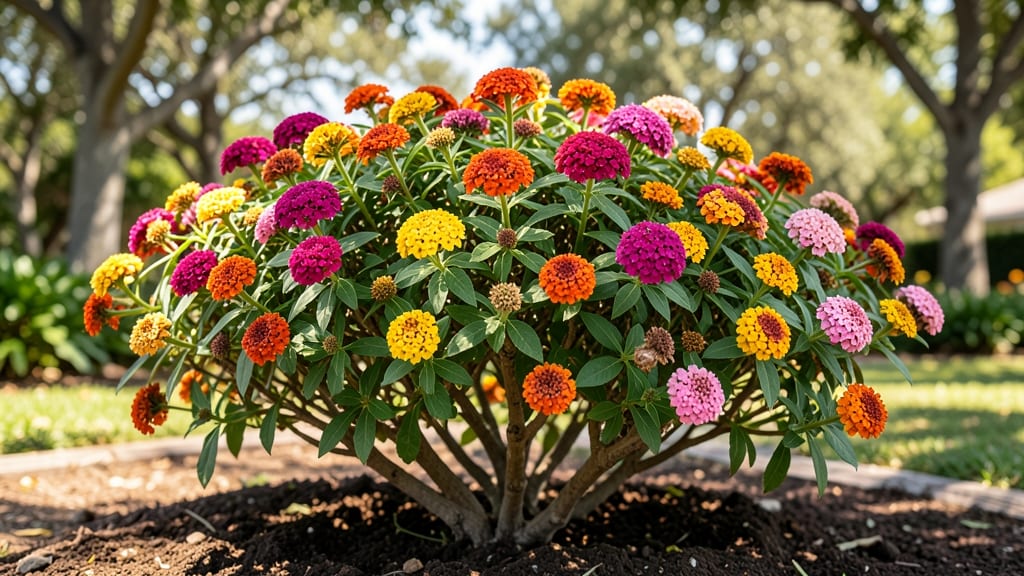
Determining whether Lantana Camara is a perennial or annual depends on your climate: it thrives as a perennial in warm zones (9-11) but dies back annually in colder regions, regrowing from roots each spring when temperatures rise.
This plant's behavior actually makes it a semi-perennial—it survives year-round in frost-free zones but acts like an annual where winters drop below 25°F. 🌱 The key difference? Its deep root system stays alive underground even when above-ground growth freezes, allowing it to bounce back faster than true annuals.
In my experience, gardeners in zone 8 often treat it as an annual but can sometimes coax it through winters with proper protection.
What's fascinating is how this plant adapts: in its native tropical regions, it grows continuously, but when transplanted to colder climates, it enters dormancy. This dual nature explains why some sources call it a perennial while others classify it as annual—it's really both, depending on your location.
The frost sensitivity is what triggers the dieback, making temperature the deciding factor in its lifespan classification.
💡 In This Article
- Why Lantana Camara Dies Back in Cold Climates
- How to Overwinter Lantana Camara in Cold Regions
Why Lantana Camara dies back in cold climates
Lantana Camara's annual dieback in colder climates stems from its tropical origins and frost sensitivity. This plant evolved in warm regions where temperatures rarely dip below 40°F, making it highly vulnerable to freezing.
When exposed to 25°F or lower, the above-ground stems and leaves freeze and turn black, a process called cold acclimation failure. Unlike true perennials that develop cold-resistant tissues, Lantana lacks this adaptation—its cells rupture when ice crystals form, killing the plant's aerial parts but leaving the roots intact.
The root system plays a crucial role in its survival strategy. Lantana develops a deep, fibrous root network that can extend up to 3-4 feet underground, storing carbohydrates and nutrients. These roots remain dormant but alive during winter, protected by the soil's insulation.
When spring temperatures rise above 50°F, the roots signal new growth, producing shoots within 2-4 weeks. This rapid regrowth is why it appears to "come back to life" each spring—though the plant itself didn't survive winter, its genetic material did.
Comparing Lantana to true perennials and annuals highlights its unique behavior. Unlike annuals that complete their entire lifecycle in one season, Lantana's roots persist year-round in warm climates. True perennials like peonies develop woody stems or underground storage organs (rhizomes) that survive winter intact.
Lantana's strategy falls in between: it's a hemicryptophyte, meaning it survives winter with protected buds at or below soil level, but lacks the cold-hardiness of true perennials. This explains why it thrives in zones 9-11 but struggles in colder regions.
The temperature threshold for dormancy is particularly interesting. Research shows Lantana begins preparing for dormancy when nighttime temperatures consistently drop below 55°F for more than 3-5 days. This triggers hormonal changes that cause leaves to yellow and fall, conserving energy in the roots.
The plant's ability to sense temperature shifts is what makes it so responsive to seasonal changes—unlike many tropical plants that would be completely destroyed by frost, Lantana's root system gives it a fighting chance to return each spring.
What most gardeners don't realize is how this dieback pattern actually benefits the plant. By dying back annually, Lantana avoids accumulating damage from repeated freeze-thaw cycles that would weaken true perennials.
The annual reset allows it to maintain vigorous growth each season, producing the bright yellow, orange, and pink flowers that make it such a popular ornamental. This survival mechanism is similar to how some bulbs (like tulips) die back above ground but regrow from underground storage structures.
One fascinating aspect is how Lantana's dieback affects its spread. When the plant dies back, the roots remain active and can produce new shoots from multiple points along the root system. This creates dense clusters of plants that appear to regrow from the same spot each year.
In warmer zones where it doesn't die back completely, Lantana can become invasive through this same root system, spreading via underground runners. The annual dieback in colder climates actually serves as a natural control mechanism, preventing the plant from becoming too aggressive in regions where it can't survive winter.