
Flowers
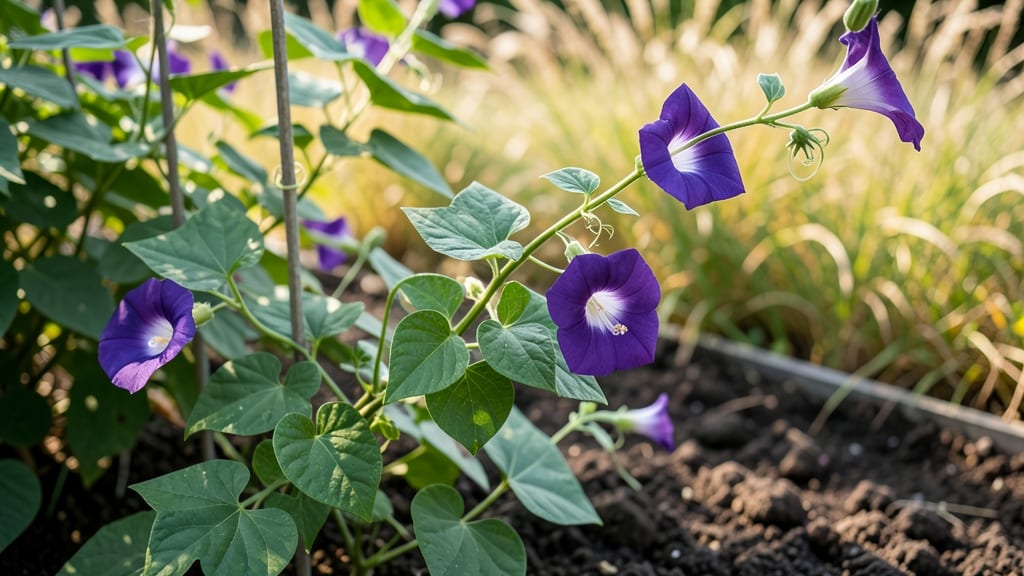
Morning glory behaves as an annual plant, though its roots can regrow vines in warm climates, mimicking perennial habits. Unlike true perennials, it doesn’t survive winter dormancy—only underground nodes enable seasonal regrowth.
This dieback cycle happens because morning glory’s roots store energy but don’t develop true perennial hardiness. 🌱 In mild winters, those underground nodes sprout new vines, tricking gardeners into thinking it’s a perennial.
True perennials, like hostas or daylilies, regrow from established root systems year after year without needing to restart from seed. The key difference? Morning glory’s roots only last one growing season before weakening, while perennial roots remain robust through multiple winters.
For gardeners, this means planning ahead: if you want continuous blooms, plant seeds or tubers every spring rather than waiting for roots to resprout. Warm climates may see more reliable regrowth, but even then, the plants won’t live beyond two or three years without replanting.
Understanding this lifecycle helps you avoid disappointment when your morning glory fades after one season—it’s not failing, it’s just following nature’s script.
💡 In This Article
- Why Morning Glory Dies Back Annually
- How to Extend Morning Glory’s Seasonal Growth
Why morning glory dies back annually
The morning glory's annual lifecycle stems from its root system, which lacks the deep, woody structure of true perennials. Instead, it develops fibrous roots that store minimal energy reserves—typically just enough to sustain the plant through one growing season.
These roots contain underground nodes (small growth points) that can sprout new vines when conditions are favorable, but they don't develop the hardy, long-lived rootstock found in perennials like peonies or asparagus.
Temperature sensitivity is the real game-changer. Morning glory thrives in warm climates (USDA zones 7-11), where soil temperatures above 60°F trigger regrowth from those underground nodes. In colder regions, the roots simply don't survive winter freeze-thaw cycles.
Even in mild winters, the stored energy depletes after 2-3 years, forcing the plant to restart from seed. This is why you'll often see morning glory resprouting in spring—it's not perennial persistence, but rather a clever survival tactic using temporary energy stores.
The biological mechanism involves a process called secondary dormancy. Unlike true perennials that enter winter dormancy with intact root systems, morning glory's roots enter a state where they can't regenerate indefinitely.
The nodes that produce new shoots contain meristematic tissue (growth cells), but these lack the protective layers that allow perennials to survive harsh winters. Think of it like a battery that charges for one season but can't recharge beyond that—eventually, it just runs out of power.
What makes this especially confusing is how morning glory's vines can grow 6-10 feet in a single season, creating the illusion of a hardy plant. The rapid vine growth is an energy-intensive process that drains the root system faster than perennial plants can replenish.
In contrast, true perennials like clematis or wisteria allocate energy to both above-ground growth and below-ground storage, allowing them to rebound year after year without replanting.
Here's the key distinction: perennial plants develop rhizomes (horizontal underground stems) or corms that contain multiple growth points protected by insulating layers. Morning glory's roots simply don't have this structural complexity.
The nodes that produce new shoots are more like temporary storage units than permanent growth centers. 🌱 This is why even in warm climates, morning glory plants typically decline after 2-3 years of growth.
For visual learners, imagine comparing morning glory's roots to a strawberry plant versus a dandelion. Strawberries have runners that spread horizontally (perennial behavior), while dandelions produce deep taproots that can regenerate—but neither is as structurally complex as morning glory's misleading regrowth system.
The vines may return, but the root system itself is fundamentally annual.