
Planting
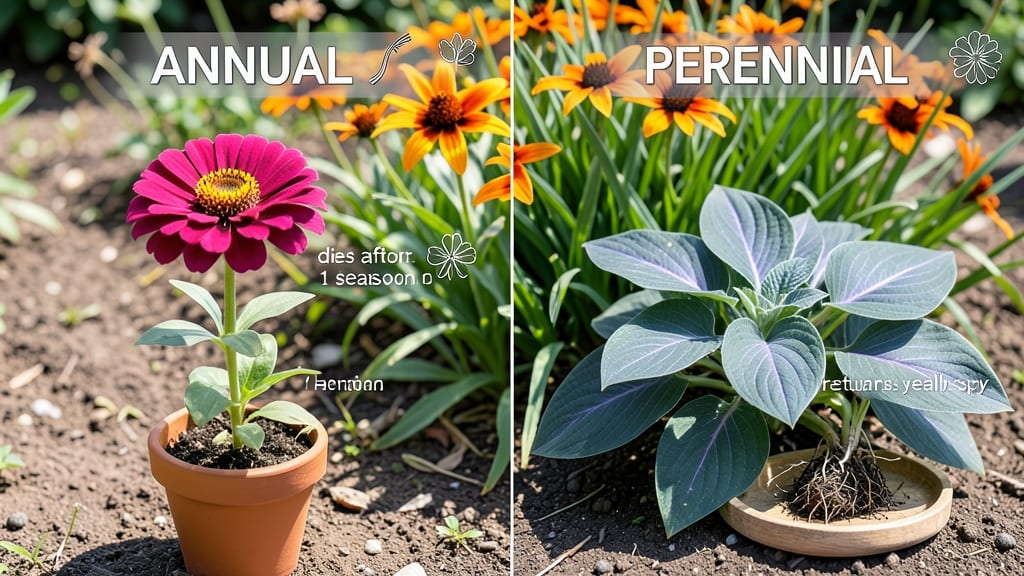
The annual vs perennial difference lies in their lifespan and regrowth patterns: annuals live and die in one growing season, while perennials return year after year from the same root system, often thriving stronger with each passing season.
Understanding this difference completely changes how you plan your garden. Annuals like marigolds or zinnias deliver vibrant color bursts but require replanting each year, while perennials such as coneflowers or lavender establish deep root systems that make them drought-tolerant and low-maintenance after their first year. 🌱 The trade-off?
Annuals give you more design flexibility for seasonal themes, while perennials provide long-term structure with minimal upkeep once established.
This distinction also affects your care routine. Annuals need consistent watering and fertilizing to complete their rapid growth cycle, while perennials often develop hardier root systems that require less frequent attention.
Many gardeners combine both types—using annuals for seasonal color accents around more permanent perennial borders—to create visually dynamic spaces with less overall maintenance.
💡 In This Article
- How Plant Lifespan Affects Growth and Care
- Choosing Between Annuals and Perennials for Your Garden
How plant lifespan affects growth and care
The most fundamental difference between annuals and perennials lies in their root systems. Annuals develop shallow, fibrous roots that spread rapidly to absorb nutrients and water during their single growing season.
This adaptation allows them to complete their life cycle quickly, often within 6-12 months, focusing energy on seed production rather than long-term survival. 🌱 Perennials, on the other hand, grow deep, extensive root systems that can reach 3-6 feet underground, storing nutrients and water for multiple seasons.
These roots often form woody crowns or rhizomes that act like biological batteries, powering regrowth each spring.
This biological difference creates distinct care requirements. Annuals need frequent watering—typically 1-2 inches per week—because their shallow roots can't access deep moisture, while established perennials may only need watering during extreme droughts once their roots are fully developed.
The soil preferences also vary: annuals thrive in well-draining, nutrient-rich topsoil, while perennials often prefer slightly rocky or well-draining soil that prevents root rot in their deeper systems. 💧
Seasonal adaptations further separate these plants. Annuals grow aggressively during their short window, often requiring monthly fertilization to maintain bloom production, while perennials enter dormancy in winter, conserving energy in their roots.
This dormancy period means perennials typically need less frequent pruning—just removing dead foliage in early spring—whereas annuals may require regular deadheading to encourage continuous flowering throughout the season.
Consider how these traits affect your garden's ecosystem. Annuals contribute to quick soil enrichment through their rapid decomposition, while perennials build soil structure over years through their deep root systems.
Many gardeners use annuals to fill gaps between perennials, creating a balanced system where annuals provide immediate color while perennials establish long-term foundation plants. 🌿
The temperature tolerance also differs significantly. Most annuals thrive in warm seasons (60-80°F) and bolt or die when temperatures drop below 50°F, while many perennials have adapted to survive winter dormancy in temperatures as low as -20°F.
This makes perennials ideal for colder climates where annuals would require replanting each spring. The trade-off? Annuals give you more seasonal variety, while perennials offer reliable year-after-year performance with minimal replanting.
One fascinating example is the difference in seed production strategies. Annuals like sunflowers devote nearly all their energy to producing seeds before dying, while perennials like peonies allocate resources to both flowering and root expansion.
This explains why you'll often see annuals producing hundreds of seeds per plant in a single season, while perennials may produce far fewer seeds but with greater genetic stability for the next generation. 🌻