
Plants
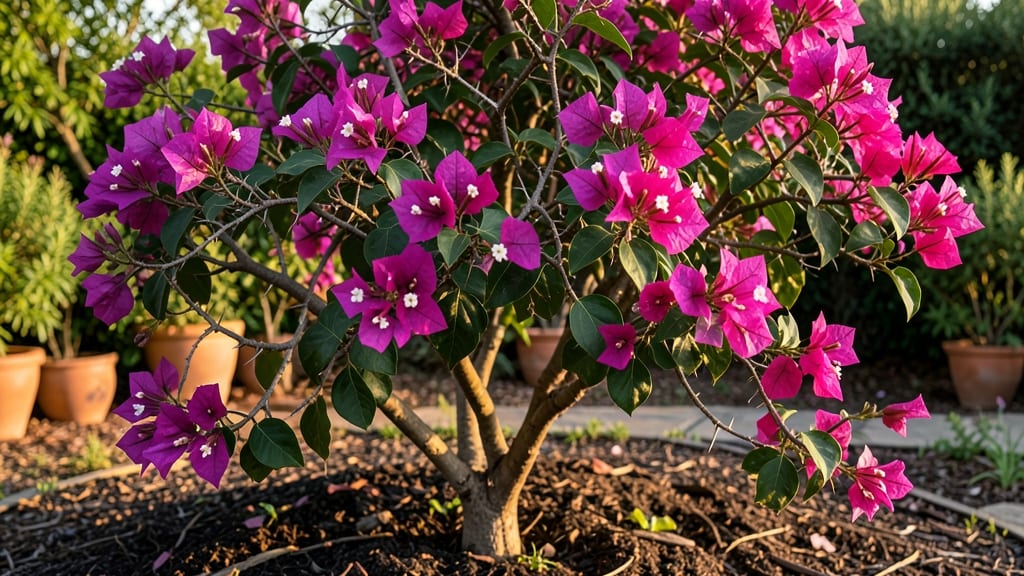
Bougainvillea plants are not perennial in cold climates—they die back to the ground when temperatures drop below 30°F (-1°C), but their roots remain alive and can regrow each spring with proper protection. In warmer USDA zones 9-11, they grow as evergreen shrubs year-round.
Bougainvillea's survival strategy is fascinating—they're technically tender perennials, meaning they won't survive freezing temperatures above ground but their root systems stay dormant until spring. 🌱 The key difference between zones is that in colder regions (below zone 9), you're essentially growing them as annuals that regrow from roots each year, while in warmer zones, they behave like true perennials.
This explains why gardeners in colder climates need to take extra steps like heavy mulching or container growing to protect the roots during winter.
What's interesting is how bougainvillea responds to temperature changes—when nighttime temperatures stay below 50°F (10°C) for extended periods, the plant enters dormancy, dropping leaves and stems to conserve energy.
The roots remain viable as long as they're protected from freezing soil, which is why proper winter care makes all the difference in getting them to bounce back in spring.
💡 In This Article
- Understanding Bougainvillea’s Perennial Nature in Cold Climates
- Protecting Bougainvillea Over Winter for Year-Round Growth
Understanding bougainvillea’s perennial nature in cold climates
Bougainvillea's survival in cold climates hinges on its unique biological response to temperature drops. When nighttime temperatures fall below 50°F (10°C) for more than a few days, the plant triggers a natural dormancy process.
This involves the abscission layer forming at the base of leaves and stems, causing them to drop while the root system remains alive underground. The roots contain meristematic cells that can regenerate new growth when conditions warm again—this is why proper winter care preserves these critical root zones.
The magic number for bougainvillea's survival is 30°F (-1°C), where above-ground tissues begin irreversible damage. However, the roots can tolerate brief exposure to 20°F (-6°C) if protected by 6-8 inches (15-20 cm) of organic mulch, which insulates against soil temperature fluctuations.
In USDA zones 9-11, bougainvillea behaves like a true evergreen perennial because winter temperatures rarely drop below 35°F (2°C), allowing continuous growth. The difference lies in the plant's ability to maintain active meristematic tissue year-round in warmer climates.
Here's what happens biologically during dieback: when temperatures drop, the plant's vascular system shuts down to prevent water loss, causing stems to become woody and brittle. The roots, however, remain metabolically active through a process called "cold acclimation," where they produce protective proteins and sugars that act as antifreeze agents.
This is why you'll often see bougainvillea regrow from the base in spring—those roots have been quietly preparing for months.
What most gardeners don't realize is that bougainvillea's regrowth cycle follows a precise timeline. After the last frost (typically when soil temperatures reach 55°F (13°C)), the roots begin producing new shoots within 2-4 weeks if conditions are right.
The speed of regrowth depends on root health, which is why winter protection isn't just about survival—it's about setting up the plant for vigorous spring growth. In colder zones, this means the plant behaves more like an annual that regenerates each year rather than a true perennial.
Consider this comparison: in zone 10, bougainvillea maintains continuous foliage because winter lows rarely drop below 40°F (4°C). But in zone 7, where winters can reach 10°F (-12°C), the plant must rely entirely on protected roots to survive.
The difference illustrates why bougainvillea is classified as a "tender perennial"—it can't withstand freezing temperatures above ground but has remarkable root resilience when properly cared for.
The science behind this involves bougainvillea's native habitat in tropical and subtropical regions of South America, where it evolved to handle seasonal dry periods rather than freezing temperatures. This adaptation explains why the plant's survival strategy focuses on root preservation rather than above-ground hardiness.
When you see bougainvillea regrow each spring, you're witnessing this ancient survival mechanism in action.