
Plants
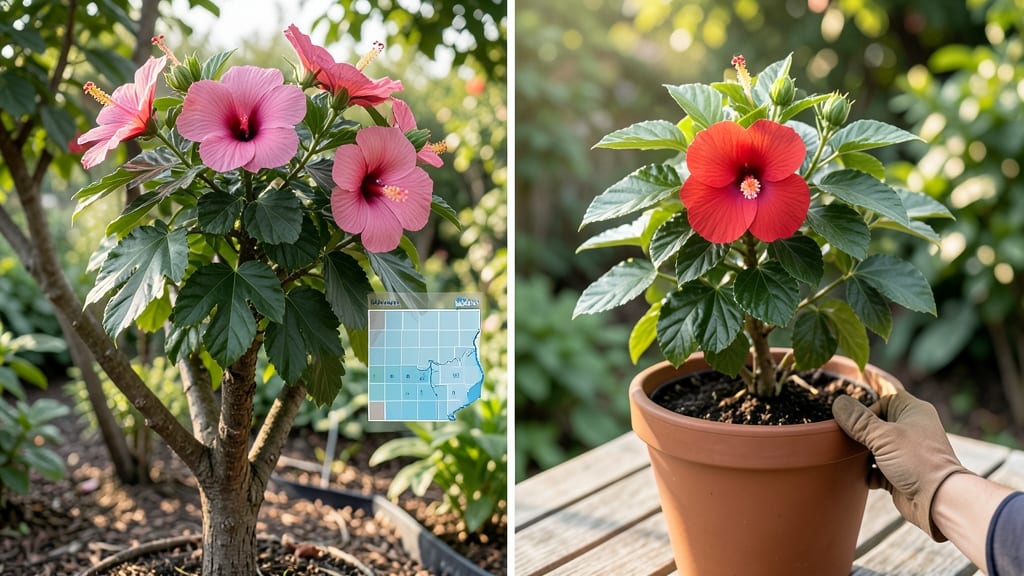
Hibiscus plants aren't true perennials in cold climates, as they die back completely when frost hits, though tropical varieties can survive in USDA zones 10-12 with protection. Hardy hibiscus regrows from roots in milder winters.
This behavior stems from hibiscus' tropical origins—most varieties evolved where winters never dip below 30°F. 🌡️ When temperatures drop below freezing, the above-ground growth blackens and appears dead, but the roots often survive underground.
The key difference lies in their classification: tropical hibiscus (like Hibiscus rosa-sinensis) are true perennials only in frost-free zones, while hardy hibiscus (such as Hibiscus moscheutos) can endure 20-25°F with proper winter prep. Even then, severe or prolonged cold will kill them back to the ground.
What makes this fascinating is how hibiscus plants "cheat" dormancy. Unlike true perennials that maintain some foliage, hibiscus stores energy in their thick roots during winter. When spring arrives and soil temperatures rise above 50°F, new shoots emerge from these dormant roots—often within weeks.
This regrowth ability is why many gardeners still consider hibiscus "perennial-like," even though botanically they're classified as herbaceous perennials with limited cold hardiness.
💡 In This Article
- Hibiscus Plant Freeze Tolerance by USDA Zone
- Winter Care Tips for Hardy Hibiscus in Cold Regions
Hibiscus plant freeze tolerance by USDA zone
The reason hibiscus plants behave differently across climates comes down to their evolutionary origins. Tropical hibiscus varieties, like the showy Hibiscus rosa-sinensis, evolved in frost-free regions where temperatures rarely drop below 30°F. Their entire structure—leaves, stems, and even flowers—isn't adapted to survive freezing.
When frost hits, the plant's cellular membranes rupture due to ice crystal formation, causing irreversible damage to above-ground growth. This is why these varieties only thrive as perennials in USDA zones 10-12, where winter temperatures stay above 35°F.
Hardy hibiscus species, such as Hibiscus moscheutos (swamp hibiscus) or Hibiscus coccineus (scarlet hibiscus), have developed different survival strategies. These plants store carbohydrates in their thick, fibrous roots during the growing season, which acts like a natural antifreeze system.
When temperatures drop to 20-25°F, the above-ground portions die back completely, but the roots remain dormant until spring. The key mechanism here is the plant's ability to enter a deep dormancy state, similar to how bulbs survive winter.
This root system can remain viable for months underground, even when soil temperatures fluctuate between 32°F and 40°F. 🌱
What's fascinating is how hibiscus plants trigger this dormancy process. As nighttime temperatures approach freezing, the plant's growth hormones shift from promoting leaf and stem expansion to root development and storage.
This hormonal change is accompanied by a reduction in water content within the cells, preventing ice crystal formation that would otherwise destroy cellular structures.
The roots themselves contain higher concentrations of protective sugars and proteins that act as natural cryoprotectants, allowing them to survive temperatures as low as 15°F for short periods.
However, there's a critical threshold where even hardy hibiscus can't survive. Prolonged exposure to temperatures below 15°F for more than 24 hours will kill the roots, as the protective mechanisms become overwhelmed. This is why gardeners in USDA zones 5-9 must take special precautions during harsh winters.
The plant's ability to regrow depends entirely on whether these root systems remain intact and undamaged through the cold season.
In milder winters (zones 7-9), hibiscus often regrows vigorously by early spring, while in colder zones (5-6), even protected plants may require several weeks of 50°F+ soil temperatures before new shoots emerge.
Consider this comparison: In zone 10, tropical hibiscus grows year-round with no dieback, while in zone 7, a hardy hibiscus may lose all foliage but regrows from roots. The difference isn't just about temperature tolerance—it's about the plant's entire physiological response to cold stress.
This is why some gardeners refer to hibiscus as "seasonal perennials" rather than true perennials—they exhibit perennial-like behavior only under specific conditions. 🌿