
Flowers
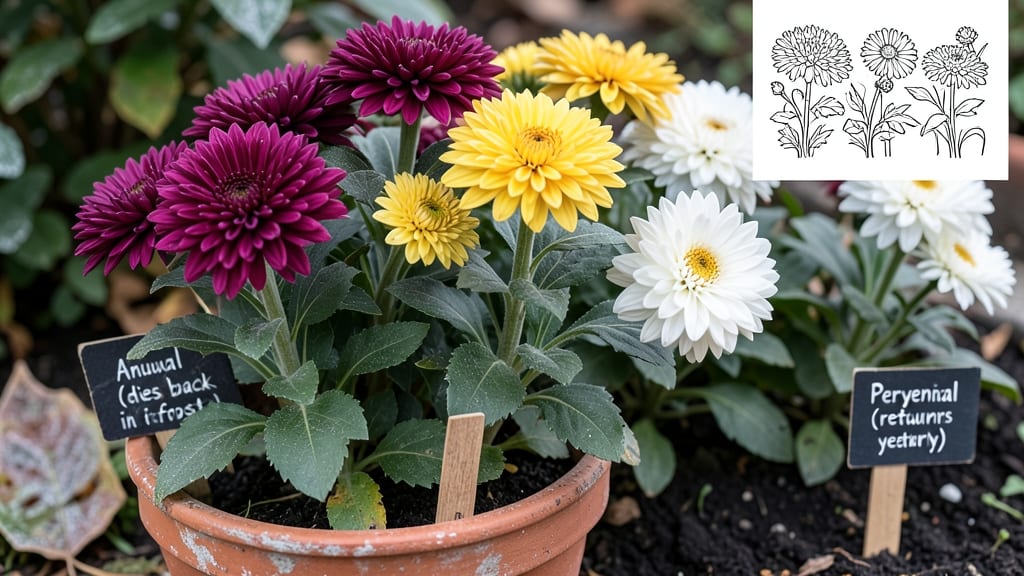
Mums are annuals or perennial flowers that die back annually in cold climates but can regrow for multiple years with proper winter care in USDA zones 5-9.
This dieback cycle is actually a survival strategy—mums go dormant when temperatures drop below 40°F, conserving energy until spring. 🌱 In warmer zones, they bloom repeatedly, while in colder areas, gardeners often treat them as annuals due to winter die-off.
The key difference lies in their hardiness: varieties like 'Autumn Joy' can survive winters with 3-4 inches of mulch, while tropical hybrids need protection or replanting each year.
For multi-year growth, I recommend cutting back dead foliage in late fall, applying a thick layer of straw mulch, and watering thoroughly before the first frost. This mimics their natural dormancy while preventing root damage.
In colder regions, overwintering mums requires patience—they'll often surprise you with fresh blooms the following season if given proper care.
💡 In This Article
- Why Mums Die Back in Cold Climates
- Extending Mum Lifespan Through Seasonal Care
Why mums die back in cold climates
Mums (Chrysanthemum spp.) undergo a natural biological process called dormancy when temperatures drop below 40°F—this isn't death, but a survival mechanism. Their leaves yellow and fall off as the plant redirects energy to its roots, which remain alive underground.
This adaptation helps them conserve moisture and nutrients during winter's harsh conditions. 🌱 In their native regions of East Asia, mums experience similar seasonal temperature shifts, making dormancy an evolutionarily advantageous trait.
The key difference between annual and perennial mums comes down to their hardiness zones. Temperate varieties like 'Autumn Joy' (USDA zones 5-9) can survive winters with proper protection, while tropical hybrids (zones 10+) lack cold tolerance.
When exposed to prolonged freezing (28°F), even hardy mums may suffer root damage. The plant's ability to regrow depends on whether its root system remains intact—a process called vernalization, where cold exposure actually signals the plant to bloom again in spring.
Think of it like a bear hibernating: mums "sleep" through winter, only to wake up and bloom with renewed vigor. The confusion arises because gardeners in colder climates often replant mums each year, mistaking their annual dieback for true annual behavior.
In reality, these plants are perennials with a 3-5 year lifespan when given proper winter care—similar to how peonies or daylilies regrow each spring after their foliage dies back.
What most people don't realize is that mum dormancy is triggered by both temperature AND daylight hours. As daylight decreases in autumn, plants produce more abscisic acid, a hormone that signals dormancy.
This explains why mums in shorter-day climates (like the Pacific Northwest) often enter dormancy earlier than those in longer-day southern regions. The plant's internal clock ensures it "knows" when winter is coming, even before temperatures drop.
Here's where hardiness zones make a practical difference: In zone 6, mums need 6-8 inches of mulch to survive winters, while zone 9 mums might only require 2-3 inches. The mulch acts like a blanket, insulating roots from temperature swings that can cause freeze-thaw damage.
Without this protection, the roots may heave out of the ground or suffer moisture loss, preventing spring regrowth. This is why many gardeners in colder regions treat mums as annuals—they simply don't get the chance to see their perennial potential.
For those curious about the science, mum dormancy involves complex biochemical changes. The plant converts stored starches into sugars that protect cell membranes from freezing damage, while anti-freeze proteins (similar to those in winter wheat) help maintain fluidity in cell contents.
This biological "winterizing" process is what allows hardy mums to survive temperatures as low as -10°F when properly protected. 💫