
Orchid Care
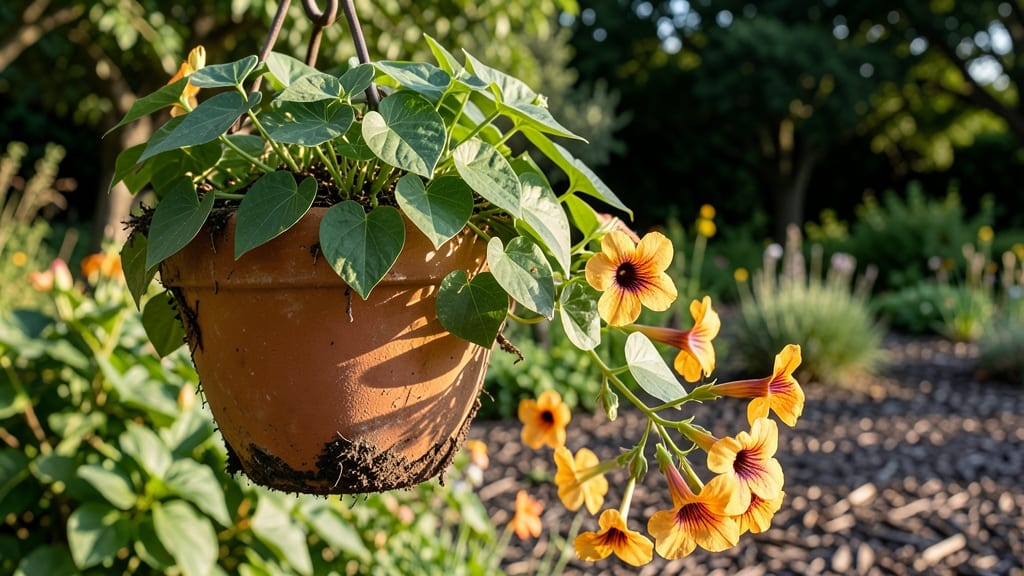
Determining whether black eyed susan vine is annual or perennial reveals it's an annual plant that completes its life cycle in one season, dying back after flowering but often self-seeding prolifically for repeat blooms the following year. Unlike perennials, it does not regrow from the same root system annually.
The black eyed susan vine's annual nature stems from its evolutionary adaptation to thrive in warm climates where frost would kill perennial roots. 🌿 Unlike hardy perennials, it focuses all its energy on rapid growth and flowering before winter, sacrificing long-term root survival for explosive summer displays.
This trait makes it perfect for gardeners who want vibrant color each year without the commitment of perennial care—though you'll need to plan for reseeding if you want next season's blooms.
What sets this vine apart is its ability to self-seed aggressively, often popping up where you least expect it. To control this, I recommend deadheading spent blooms or collecting seeds for intentional replanting.
The trade-off? You get stunning golden-yellow flowers from early summer until frost, with minimal maintenance beyond occasional pruning to encourage bushier growth.
💡 In This Article
- Why Black Eyed Susan Vine Dies Back Each Year
- Maximizing Annual Black Eyed Susan Vine Growth
Why black eyed susan vine dies back each year
The black eyed susan vine's annual life cycle is a strategic adaptation to its native warm climates. Unlike perennials that invest in root systems to survive multiple winters, this vine allocates nearly all its energy to rapid above-ground growth and prolific flowering during its single growing season.
Botanists call this "monocarpic" growth—where a plant focuses entirely on reproduction before dying. 🌱 This explains why you'll see vibrant blooms from early summer until frost, followed by complete dieback when temperatures drop below 40°F.
What makes this vine unique is its flowering mechanism. Each plant produces thousands of tiny seeds within its distinctive 1-inch daisy-like blooms, which mature in just 4-6 weeks after pollination.
The energy cost of seed production is so high that the plant's roots and stems simply can't sustain both flowering and winter survival simultaneously. Compare this to perennial vines like morning glory, which develop deep root systems that store energy for regrowth each spring.
The vine's life cycle also reflects its native habitat in the southeastern United States, where winters are mild but still cold enough to prevent perennial growth. This adaptation gives gardeners in similar climates stunning seasonal color without the long-term commitment of perennial plants.
The trade-off? You'll need to plan for reseeding if you want next year's display, as the parent plant won't return.
Interestingly, the vine's self-seeding behavior is actually a survival strategy. Each seed contains enough energy to germinate quickly in spring, creating dense stands that outcompete weeds.
This aggressive reseeding explains why black eyed susan often appears where it wasn't intentionally planted—it's nature's way of ensuring genetic continuity without relying on perennial roots. 🌿 For gardeners, this means you'll either get free regrowth or need to actively manage seed dispersal.
What most gardeners don't realize is how this annual habit affects the plant's growth pattern. Unlike perennials that grow steadily throughout the season, black eyed susan vines experience a growth "rush" during spring and early summer, reaching heights of 6-10 feet in just 8-10 weeks.
This rapid growth is possible because the plant isn't diverting energy to root maintenance—everything goes toward stem elongation and flower production.
The botanical term for this is "determinate growth," where the plant's development is genetically programmed to complete within one season. This differs fundamentally from perennial vines like wisteria, which grow continuously over multiple years.
The black eyed susan's strategy makes it perfect for temporary color displays or container gardening where you don't want permanent plants.