
Planting
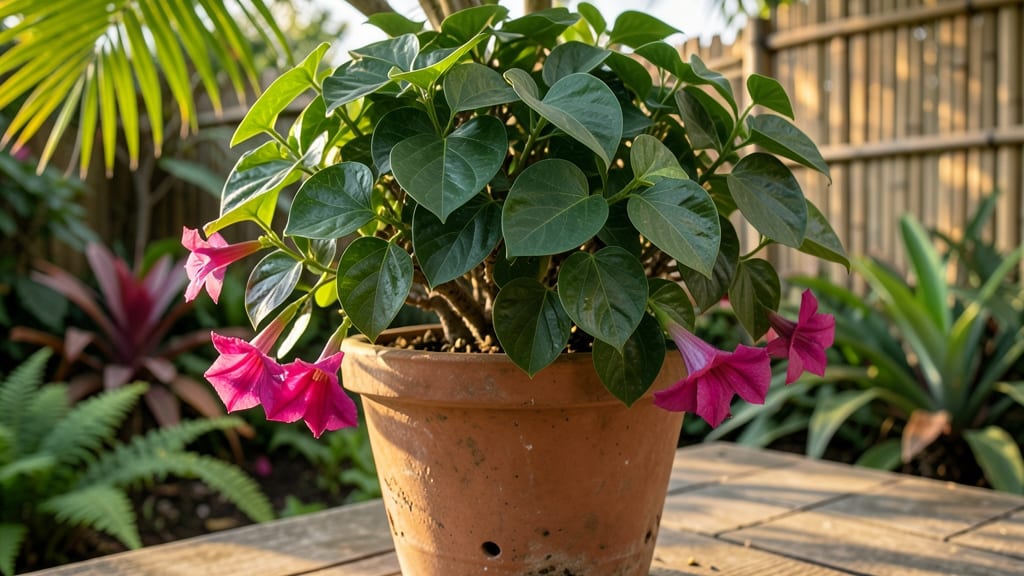
Dipladenia plants act like perennials only in frost-free zones (USDA 10-11), since they die back completely in cold weather but regrow from their tuberous roots each spring when temperatures warm.
The key to understanding dipladenia's behavior lies in its tuberous root system, which stores energy for regrowth. 🌱 In warmer climates where winter temperatures rarely drop below 30°F, these roots survive underground, allowing the plant to return each spring.
However, in colder regions, the above-ground growth freezes and dies, making dipladenia behave more like an annual unless you take protective measures. This distinction is crucial for gardeners planning long-term landscapes—what appears to be a perennial in one zone may require annual replanting or overwintering in another.
What sets dipladenia apart is its ability to regenerate from even small root fragments, which explains why some gardeners report "perennial" behavior in protected microclimates. The plant's natural dormancy cycle is triggered by temperature shifts, not just seasonal changes.
For example, in USDA Zone 8, you might see partial survival with mulch protection, while Zone 5 typically requires digging up tubers entirely. This adaptability makes dipladenia a favorite for container gardening in cooler areas.
💡 In This Article
- Understanding Dipladenia’s Growth Cycle and Cold Hardiness
- How to Overwinter Dipladenia in Cold Climates
Understanding dipladenia’s growth cycle and cold hardiness
Dipladenia plants store energy in thick, tuberous roots that resemble small potatoes—these specialized underground structures allow them to survive harsh conditions. When temperatures drop below 40°F, the plant triggers a natural dormancy cycle, shedding leaves and stems while the roots remain dormant.
This process is similar to how dahlias or cannas behave, but dipladenia's tubers are more delicate and less cold-resistant than those species. In frost-free zones like Florida or Southern California (USDA 10-11), these roots can remain active year-round, making the plant appear perennial.
The critical threshold for survival is 28°F—any colder, and the tuberous roots begin to freeze, losing their ability to regenerate. This explains why dipladenia thrives as a perennial in coastal areas where winter highs rarely dip below 50°F, but struggles in inland regions with sharper temperature swings.
The plant's growth cycle is tightly linked to soil temperature: roots won't sprout until the ground reaches 60°F, which typically happens in late spring or early summer in warmer climates.
What makes dipladenia unique is its ability to regenerate from even tiny root fragments—just 1-inch pieces can produce new shoots. This explains why some gardeners in marginal zones (USDA 9) report partial survival with heavy mulching.
The trade-off is that these regrowths often produce smaller, less vigorous plants compared to those growing in ideal conditions. In colder zones (USDA 8 and below), the entire root system typically freezes unless protected, which is why many gardeners treat dipladenia as an annual in these areas.
Temperature isn't the only factor—soil drainage plays a crucial role. Dipladenia tubers rot if left in soggy soil during winter, which is why well-draining containers or raised beds are essential for overwintering.
The plant's natural habitat in tropical and subtropical regions means it's not adapted to handle prolonged cold or wet conditions. Even in mild climates, heavy winter rains can cause tuber rot if drainage isn't adequate, making proper site selection just as important as temperature management.
Here's what happens biologically during dormancy: The plant converts stored starches in the tubers into sugars that protect cellular structures from freeze damage. This process is similar to how bulbs like tulips survive winter, but dipladenia's tubers lack the protective outer scales that make bulbs more cold-hardy.
The lack of these protective layers means dipladenia tubers are more vulnerable to both freezing and moisture-related damage during winter months.
For gardeners in transitional zones (USDA 9-10), the key is understanding this balance: While dipladenia may not survive winter outdoors, its tuberous nature means it can be easily propagated from cuttings or stored roots.
This makes it a practical "perennial" for those willing to put in minimal overwintering effort, as even small root fragments can be replanted in spring to produce new plants. The plant's adaptability to regrow from fragments is what gives it a "second chance" character in gardening.