
Tools
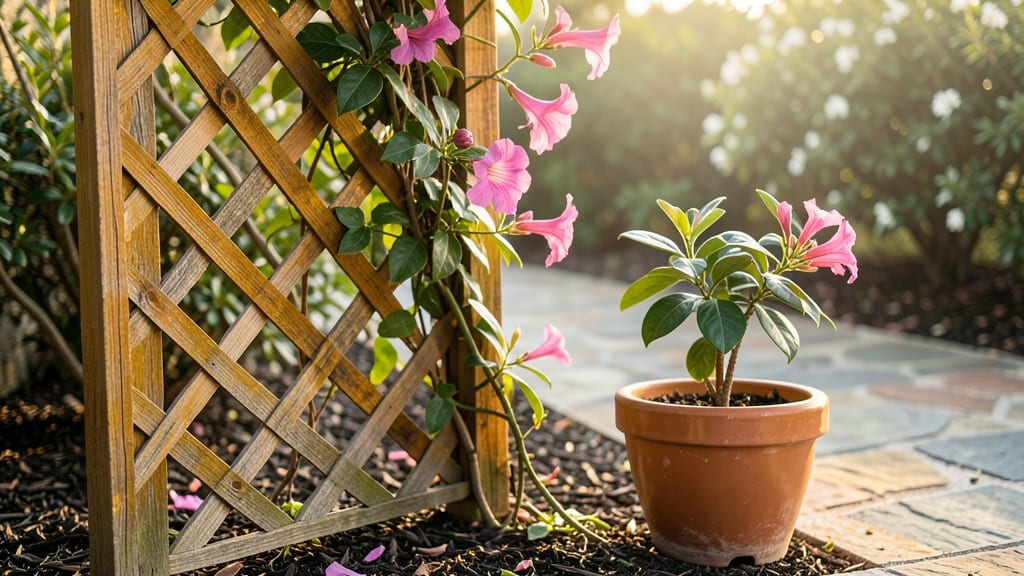
Whether mandevilla on a trellis is annual or perennial depends on your climate zone: it thrives as a perennial in USDA Zones 9-11, where its roots survive winter to regrow each spring, while in colder regions it dies back completely unless you dig it up and overwinter it indoors. The stems always freeze back, but the root system remains viable in frost-free areas.
This behavior comes down to mandevilla's tropical origins—it evolved to handle warm winters but can't tolerate frost. 🌿 In frost-free zones, the roots stay dormant but alive through winter, shooting up new growth when temperatures rise.
That's why gardeners in Zones 9-11 can treat it like a perennial vine, while those in colder areas must either grow it as an annual or take it indoors each fall.
The key difference is that Zone 9-11 plants regenerate from their established root systems, while colder-climate plants would need to start fresh each year without protection.
The trellis structure itself doesn't change this cycle—it's purely about the plant's biological response to temperature. That's why you'll see mandevilla sold as both annual and perennial depending on where you live.
The good news? Even in colder zones, with proper overwintering care, you can keep the same plant year after year—it's just the stems that need to be replaced annually.
💡 In This Article
- Mandevilla’s Perennial vs. Annual Growth in Different Climates
- How to Overwinter Mandevilla for Year-Round Trellis Beauty
Mandevilla’s perennial vs. annual growth in different climates
Mandevilla's growth cycle hinges on its tropical roots—literally. The plant evolved in South America's warm climates where temperatures rarely drop below 40°F. In USDA Zones 9-11, where winters stay above 25-30°F, the plant's root system remains dormant but alive through winter, protected by the soil's insulation.
This root hardiness (typically surviving down to 28°F with mulch) allows it to regrow from the same roots each spring, making it perennial in these frost-free zones.
The key temperature threshold is 32°F—when stems encounter frost, they die back completely, but the roots often survive if protected. In colder zones (8 or below), even the roots may perish without intervention, forcing annual replanting.
The trellis structure doesn't affect this cycle; it's purely about the plant's biological response to temperature extremes. Think of it like a tropical houseplant that can't tolerate your AC running all winter—it'll die back but might revive if you move it to a warmer spot.
Here's where the science gets interesting: mandevilla's growth hormones shift with temperature. In warm zones, auxin production (the plant growth hormone) ramps up in spring, triggering new stem growth from the roots. In colder zones, this process halts until you manually restart it by overwintering the roots indoors.
The plant's natural dormancy period in frost-free zones is about 3-4 months—just enough to survive winter without active growth.
Visual differences help distinguish perennial vs. annual behavior. In Zone 9-11, you'll see the same trellis filling with vibrant blooms year after year from the same root system. In colder zones, annual plants will show no regrowth until you replant new cuttings or tubers.
The trellis itself may look identical, but the plant's biological age differs completely between these scenarios.
Consider this comparison: A mandevilla in Miami (Zone 10) might have 5-7 year old roots producing annual stems, while one in Chicago (Zone 5) would need complete replanting each season unless overwintered.
The root system's age and health determine whether the plant acts perennial or annual—it's not about the trellis or even the stems, but what's happening below ground.
What most gardeners miss is that even in colder zones, the roots can sometimes survive if heavily mulched (4-6 inches of organic mulch) and protected. I've seen Zone 8 gardeners successfully overwinter mandevilla this way, though it requires vigilant monitoring.
The difference between annual and perennial behavior often comes down to just a few degrees of winter protection.
Think of mandevilla's growth cycle like a tropical bird adapting to different climates—it can thrive as a permanent resident in warm zones but needs to migrate (or be moved indoors) to survive colder winters. The trellis is just the stage for this performance, not the reason for the behavior. 🌿