
Planting
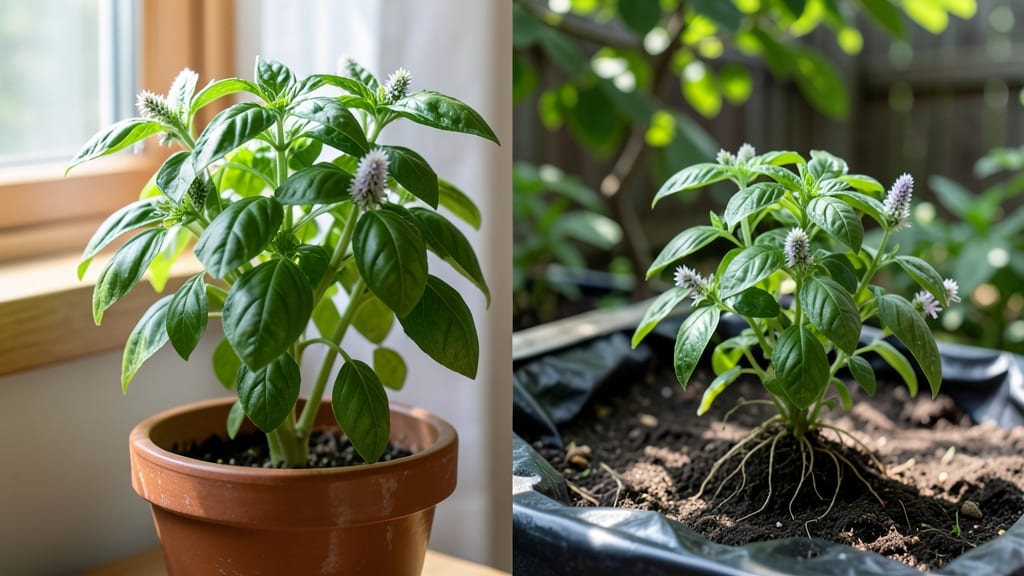
Whether basil is a perennial or annual plant depends on your climate: in most regions, it's an annual that dies back after seeding, but in frost-free zones like USDA Hardiness Zones 10-12, it can regrow from roots and act like a tender perennial.
Basil's lifecycle shifts dramatically based on temperature. In cooler climates, the first frost triggers its natural dieback, completing its annual growth cycle. 🌱 However, in warmer zones, basil's roots can survive winter with proper protection, allowing it to resprout and produce leaves for multiple growing seasons.
This dual behavior explains why gardeners in different regions treat it differently—some harvest it once, while others nurture it as a long-term herb garden staple.
What makes this particularly interesting is how basil's growth stages align with botanical definitions. Annual plants complete their life cycle in one season, while perennials regrow year after year.
Basil's ability to persist in frost-free areas demonstrates how environmental factors can override its "annual" classification, creating a fascinating gray area in plant taxonomy.
💡 In This Article
- Why Basil Dies Back: Climate and Growth Cycle Science
- Extending Basil’s Lifespan: Overwintering and Regrowth Hacks
Why basil dies back: climate and growth cycle science
Basil's lifecycle hinges on temperature sensitivity, particularly its intolerance for frost. At the cellular level, basil's leaves contain high concentrations of water (about 85-90% of its fresh weight), which freezes and ruptures cell walls at temperatures below 32°F.
This damage triggers a cascade of metabolic shutdowns, causing the plant to wilt and die back. The process mirrors how other tender herbs like cilantro or dill react to cold—all three share similar tropical origins where freezing temperatures never occur naturally.
Botanically, basil's annual classification stems from its seed-driven growth cycle. In temperate climates, it germinates in spring, grows rapidly through summer, flowers, and produces seeds by early fall—completing its lifecycle before winter arrives.
The seeds themselves remain dormant until temperatures rise again. 🌱 What's fascinating is how this aligns with annual plant definitions: a species that completes its life cycle within one growing season.
However, in frost-free zones like Florida or Southern California (USDA Zones 10-12), basil's roots can survive winter if protected, allowing it to break dormancy and regrow from the same root system.
The key difference between annual and perennial behavior lies in basil's response to temperature extremes. In cooler regions, the first frost acts as a natural "kill switch," terminating the plant's growth.
But in warmer climates, basil's roots contain meristematic cells that remain viable through winter, capable of producing new shoots when conditions improve. This root survival mechanism is what allows basil to function as a perennial in suitable environments—though it's technically still an annual species by botanical definition.
Here's what's happening at the physiological level: basil's growth is regulated by photoperiod (day length) and temperature cues. As days shorten in autumn, basil plants shift from vegetative growth to reproductive mode, producing flowers and seeds.
This process is triggered by hormones like gibberellins and ethylene, which accelerate as temperatures drop. In frost-free areas, these same hormonal signals don't necessarily lead to plant death because the roots remain insulated and hydrated, allowing the cycle to restart.
Consider this comparison: in Zone 5 (where winters drop below -15°F), basil plants typically die completely after frost. But in Zone 10 (where winters rarely fall below 30°F), the same basil variety might produce leaves for 3-4 years if given proper care.
The difference isn't in the plant's genetics but in how environmental factors interact with its natural growth patterns. 🌿 This climate-dependent behavior creates what botanists call an "ecotype"—local variations of the same species adapted to specific conditions.
What most gardeners don't realize is how basil's flowering stage directly impacts its lifespan. When basil flowers, it signals the beginning of the end for annual plants—the energy shifts from leaf production to seed development.
In perennial environments, this flowering isn't necessarily fatal because the root system remains intact, allowing the plant to reset its growth cycle. The key takeaway is that basil's classification as annual or perennial isn't fixed—it's a dynamic response to climate.